A FOOTBALL LIFE-HAROLD BELL VIRGINIA SAILORS CHAMPIONS-1965-1966-1967
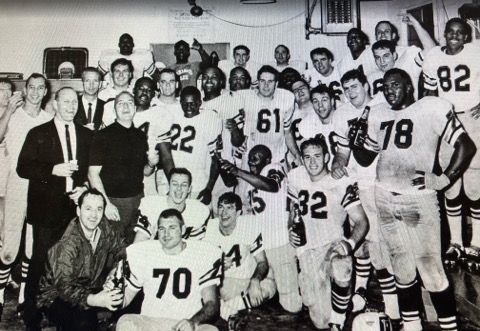
THE DMV ANNAPOLIS/VIRGINIA SAILORS BACK TO BACK THREE-PEAT CHAMPIONSHIPS
Members of the 1965 Championship celebrate at Ladd Stadium in Mobile Alabama. The DC Public School grads and Washingtonians read like a who’s Who: Number 22, is the great cornerback, and punt returner, Robert “Blue” Johnson (Cardozo) standing directly to Johnson’s left is RB Bob Headen (Cardozo), standing directly behind Johnson the great player/coach Earl Richards (Armstrong), standing two players to Johnson’s left in is the great Woodrow Wilson All-Met running back, Mike Summer. Summer played briefly for NFL Baltimore Colts, and later became a surgeon in a Hagerstown, Maryland Hospital. I am standing tall No. 82 (Spingarn). I was always open, and I never saw a football I could not catch.
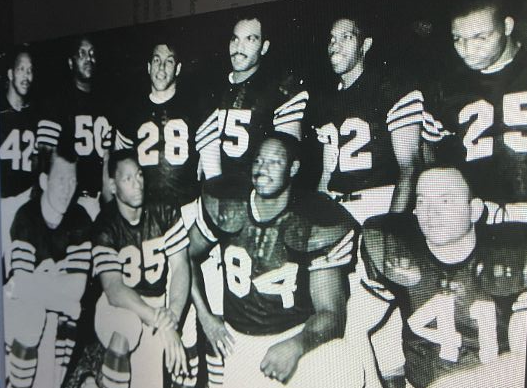
Native Washingtonians: Kneeling-Joe Mona-Charlie Mayo-Bob Headen-Dan Droze
Standing: Mo Tighman-Earl Richards-Mike Summers-?-HBell-Norris Little
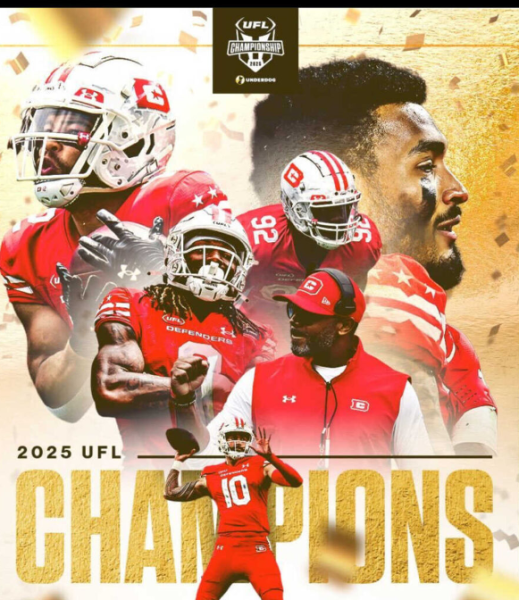
The defending champions, the DC Defenders had a chance to edge closer to the Virginia Sailors consecutive back to back championships on Saturday June 13, 2026 in the United Bowl in Washington, DC. The Louisville Kings came from behind to win 27-20 in their inaugural season.
The lost killed the chances of the Defenders edging closer to the Sailors back to back wins in three consecutive seasons, 1965-1966 and 1967.
The Sailors were originally members Atlantic Coast Football League. In 1965 they were the Annapolis Sailors when they beat the Mobile Tarpons in Mobile, Alabama at Ladd Stadium for their first championship season. The Sailors would move the franchise to Northern Virginia in 1966, it was here they won consecutive titles in 1966 and 1967.
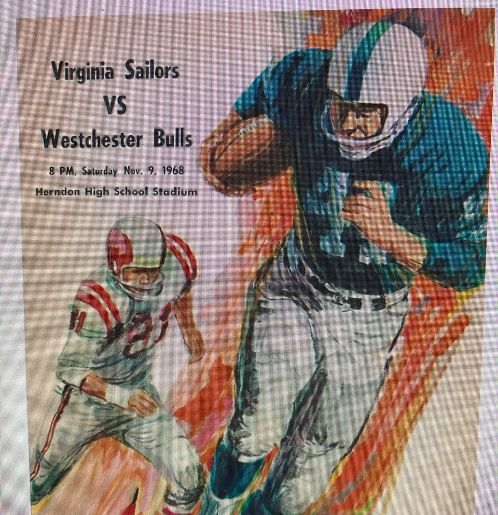
PROGRAM FROM WINNING OUR 1967 CHAMPIONSHIP GAME-GIVING US AN UNHEARD OF THREE-PEAT
Historical record for the Sailors will show they beat the Lowell Giants (affiliate of the New York Giants) on November 19,1966 in Alexandria, Virginia at George Washington High School. The tickets for the game were 50 cents.
We beat the West Chester Bulls in 1967. It was a “Hat Trick” for me winning three straight championships in the minor leagues.
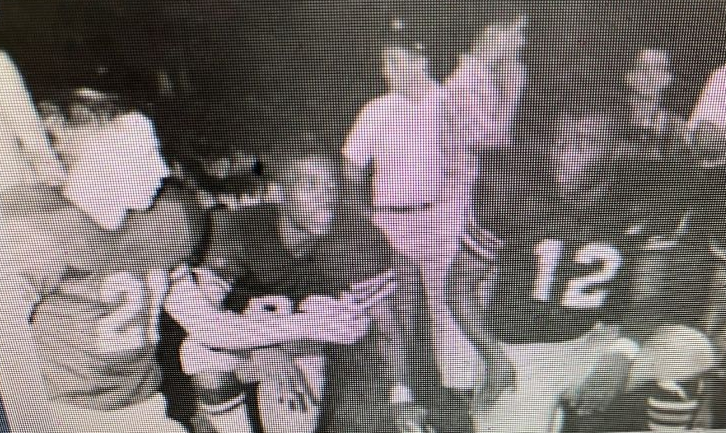
QB John Thomas-Southern University was the glue that that held the Virginia Sailors together. He could run, pass and out think any defense in the league. Coach Billy Cox, rotated three-wide receivers, Ed Butner, Ricky Hernandez and me. Hernandez had speed to burn.
Under Head Coach Billy Cox, a former Redskin player himself, the Virginia Sailors became a dominant powerhouse in the Atlantic Football League. In three years of our existence we had a record of 25-6.
I had retired with most the DC crew when the team moved the Franchise to Roanoke, Virginia. Coach Cox returned to the title game in 1968 with a chance to win a forth straight title. He loss on the road to the Hartford Knights 30-17.
My fondest memories of the Sailors were with Joel Kaufman the owner of Kay Jewelers. He took us “First Class”, on the road we stayed at the Holiday Inn, and we traveled by air.
Mr. Kaufman stayed out of sight allowing Coach Cox, and his staff to coach the players without interference. We were like family.
There was another great memory, Mr. Kaufman tried to drum up attendance at our games. He created some nation headlines in 1966 by suggesting, he planned to offer Cassius Clay a substantial sum of money to play pro football if he lost his May 21st Heavyweight Championship bout to Henry Cooper in London.
I will never forget the May 21st offer, it was on my birthday. Cassius knocked out Cooper in six rounds. Mr. Kaufman never had to make good on his flight of fancy.
The Atlantic Coast Football League of 1962-1973 was the closest pro football has ever come to having a true “Triple A Minor League, similar to Major League Baseball.
DB Ted Vactor, kicker Curt Knight and RB Ray McDonald were several of my teammates. McDonald was built like Jim Brown, but ran the football like James Brown.
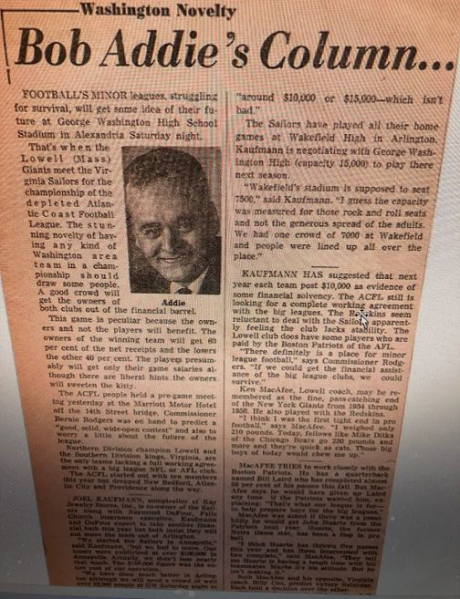
IN 1967 WASHINGTON POST LEGENDARY SPORTS COLUMNIST BOB ADDIE WROTE A COLUMN THAT MADE THE VIRGINIA SAILORS THE TOAST OF THE TOWN.

My running partner Ed Butner & I Celebrate our third straight Atlantic Coast Championship (Hat Trick).
No team in the history of Washington football can match the accomplishments of the Virginia Sailors. Beginning with a championship in Annapolis in 1965, and continuing after the club’s move to Northern Virginia, the Sailors captured three consecutive league titles, and I played on all three teams.
The Sailors have established themselves as one of the most successful football organization ever to represent the DMV. There is a noteworthy distinction, very few players can say they were members of three consecutive championship teams, included, the NFL or minor league teams.
None became influential figures in sports media as me. My combination of my playing career with the Virginia Sailors and my later work as a pioneer in sports talk radio makes me, one of a kind. My perspective spans both the playing field and the broadcast booth is unheard of.
In high school I was a headache for my coaches, I always wanted the ball in my hands, especially, when the game was on the line. My confidence was mistaken for selfishness. My baseball coach, Leo Hill, asked me to turn in my uniform after I had stolen second base, and third base, Coach Hill called time out, and walked over to third base, he politely said, “Bell great job, it is the 7th inning and the score is 5-4 hold your position. Our best hitter Donald “Cornbread” Malloy was coming to bat.”
I said, “Okay coach”, before he he could get to back to the bench, I tried to steal home. I was out by a mile-game over. On our arrival back to school, Coach Hill came in the locker room, and asked me to turn in my uniform. He walked out of the locker room saying, “There is only one Willie Mays, and he plays in New York City.”
Moving to football, the coach was Dave Brown, he had to lock me on the bus at half-time against our next door neighbor Phelps Vocational. He overheard me blaming QB Duck Wills after I jumped off-side before the snap count.
What bothered me, I caught a touchdown pass, and it was called back. I was blaming Duck, and had no idea Coach Brown was listening as we headed for the bus for half time. We were playing at Eastern High School, Phelps was the home team, but had no field to play on.
Again thinking I was the man, I wanted the ball, The Phelps defensive backs were shutting me down, with double teams, and they were shutting us out-0-0.
Once on the bus, Coach Brown addressed the problem I had with Wills. He asked me to explain myself. I said, “Coach I could not hear Wills calling the signal.”
Coach Brown’s response, “Son you are at the end of the line, all have to do is look down the line and watch for when the ball is hiked.”
He then went over the game plan for the second half, and we started to get off the bus heading back to the field of play. Coach Brown stopped me in my tracks and said, “Bell, stay here on the bus, we are going to try to win this one without you.”
They did win without me-Wills returned a punt 60 yards to win the game 6-0. A lesson learned-no one is indispensable. I had a pretty good year, and I was expecting to be named to the All-High Football team. I closed out the year with a touchdown catch, and returned an interception for a touchdown in a win against McKinley Tech High School.
Coach Brown busted my bubble, when someone mentioned my name for All-Star team, he said, “No, we got Bell listed for next year.” I had no ideal, the coaches selected members of their team for those honors. I was disappointed, but it was out of my hands.
Well there was still basketball season, Coach William Roundtree invited me to try out for the team. They were loaded with talent. There was Duck Wills, Irving Brown, Andrew Johnson, Spotswood Bolling, Slim Coleman. Lyman Williams, a tough roster to make.
Coach Roundtree, had already decided to make me a defensive stopper a basketball maneuver called “The Box in One.” I was assigned to play the other team’s hot shooter, while everyone else played a zone defense. I felt special at first coming off the bench to guard the other team’s star player.
That did not last for long, the newspaper stories went to the top scorers. Going into my senior year, I spend my time on the basketball courts at Brown, and Kelly Miller Middle schools developing, the art of shooting and scoring.
Big mistake, I messed up the chemistry of what could have been a threat to win the East against a powerful Eastern High School team. They had Bernie Chavis, Bobby Johnson, Robert Cephas, Jimmy “Blondie” Jones, Ronnie Bruce, and James “Pretty” Thomas. They were our rivals, and “The Beast of the East.”
To make a long story short Coach Roundtree, kicked me to the curve, and decided to promote several players up from the junior varsity. I transferred from Spingarn to Eastern, and was welcome by basketball Coach Bobby Hart with open arms.
I was brought back to earth when Spingarn protested my transfer to Eastern to play basketball. The school upheld the protest. It looked like I was trying to go to hell in hurry. The streets were about to claim me when one evening Coach Brown walked into the pool room across the street from Spingarn. He took me to get a hot dog and soda at a carry-out on the corner.
It was there he convinced me to return to school and finish my education. I enrolled in Fairmont Heights High School in Prince Georges County in September 1959. The coaching staff was told by Coach Brown to restrict me one sport-football. The restriction served me well. I was named to the first team All-County wide-receiver, and I graduated on time and kept it moving.
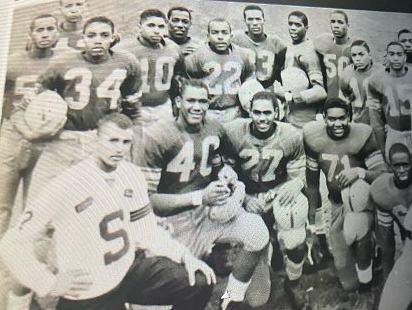
THE SPINGARN HIGH SCOOL 1957 FOOTBALL TEAM-I AM STANDING IN THE BACK WITH MY HELMET UNDER MY ARM.
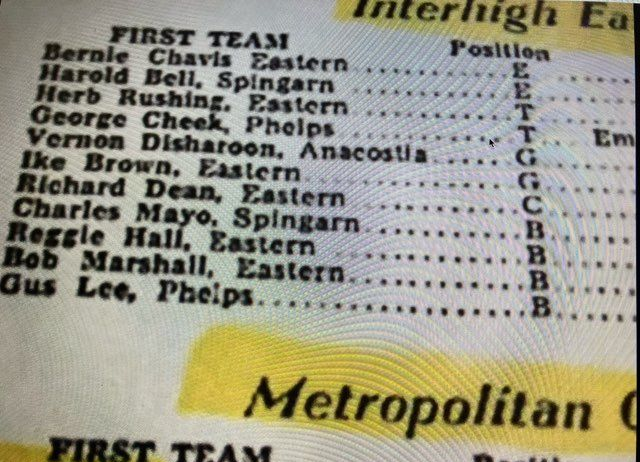
I was honored to be named to the First Team All-East in 1958. Looking back, my selfishness was a handicap.
My being a star athlete in high school help to influence other young athletes in my Parkside/Mayfair Community. The young athletes that followed me reads like a Who’s Who, include, Kenneth Springfield, Alphonso Lawson, Cecil Turner, Gus Lee, Roger Scott, and Darryl Hill all became All-Star athletes, Springfield, Lawson and Turner all enrolled at Spingarn behind me. Lee, and Scott chose Phelps Vocation, and Hill made his mark in the Catholic league at Gonzaga
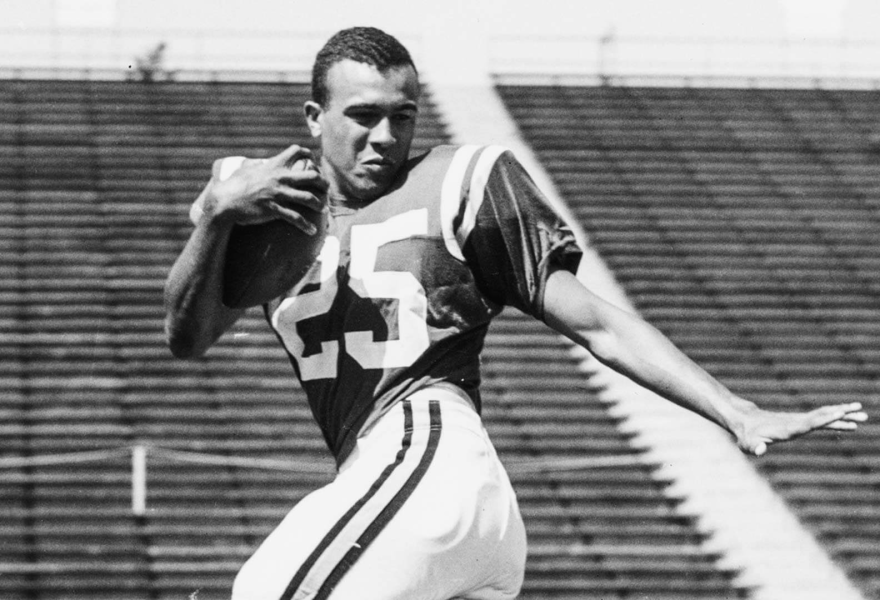
Before Darryl broke barriers at the Naval Academy and the University of Maryland, he was a young athlete from a northeast Washington’s Parkside/Mayfair community. Future NFL kick returner and record breaker, Cecil Turner and other talented athletes all came from the same neighborhood.
Darryl, became a pioneering football player who broke the color barrier while playing high school football at Gonzaga in DC. His graduating class was 1960. While there, he became the first Black to play football for Gonzaga. He helped lead the team to the City Championship in 1959.
For Darryl, there would be a lot more first in his life. In 1961 he entered the Naval Academy through a Congressional Appointment after spending a year at Xavier University. At Navy, he became one of the first Black to play at a U. S. service academy.
He starred on the freshman team. One of his teammates was future Hall of Fame quarterback, Roger Staubach, who frequently threw to Hill. Darryl, led the freshman team in all-purpose yardage and helped it compile an 8-1 record.
Darryl was first described as the first Black American player at Navy. Later research uncovered that other Black Americans had appeared on Navy freshman rosters before him, but he was among the earliest, and the most successful.
There were other first to uncover, assistant coach Lee Corso recruited him to the University of Maryland. Corso and head coach Tom Nugent believed Darryl had the talent and character to help integrate Maryland football and the Atlantic Coast Conference.
His breakthrough at Maryland in 1963 was one of the most significant milestones in the integration of major college football in the south.
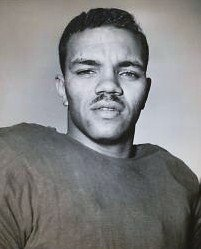
THE CONTROVERSIAL AVATUS “JUICE” STONE A DC LEGEND & ICON
Darryl, owe his success to his mother, and the legendary Avatus Stone. Avatus, made his name as one of the greatest all around High School athletes to come out of DC. He was the second black to play football at Syracuse. He followed in the footsteps of another native Washingtonian, Sidat Wilmet Singh. Singh is considered one the greatest football players to play at Syracuse.
Avatus, left Syracuse early to play in the NFL, but ended up In the Canadian Football League. He won several championships, and was the MVP with the Ottowa Roughriders.
Avatus, returned home to coach, and teach at Phelps Vocational High School. He was a family friend of the Hills. When Darryl’s mom would bring him to the field on Kenilworth Avenue behind the DGS Food store to play catch, she did not promise him a rose garden.
She would leave him and go back home to their apartment. Darryl, would follow behind her crying, with bruises from the knuckle heads from the projects. Mother Hill, would bring him back the next day and leave him again. The same routine would follow. He will follow her back home with cries of foul.
The next time he came to the field, he was locked, and loaded with Avatus by his side. Avatus brought some order to our madness. We continued to give Darryl the blues under the watchful eyes of coach, Avatus Stone. The rest is American History.
Cecil Turner, became an outstanding all around athlete at Spingarn. He was an All-Met wide receiver and track and field standout.
He received a scholarship to Cal Poly University, and was drafted by the Chicago Bears. Cecil tied an NFL record when he returned four kick-off returns for touchdowns in 1970 his rookie year.
H shares that great rookie performance with Travis Williams of the Green Bay Packers.
NOTEWORTHY: Cecil’s coach was Perry Moss when he arrived to the Bear’s training camp in 1970. Moss was the Offensive Coordinator. Moss was my head coach in the minor leagues for the Charleston Rockets. I left college to chase my NFL dreams. The Rockets played in the Continental football league.
My first week in camp, I caught everything thrown in my direction. I was asleep in the middle of the night when an assistant coach woke me up with the bad news, I didn’t make the cut. He gave me an envelope with a five-dollar bill, and wished me well.
I would read later, Moss was named the Coach of the Year in the Continental League, and later was hired by the Chicago Bears. Proving he was right in cutting me-I think.
Football taught me that every cut isn’t the end of a story. Sometimes it is just the opening kickoff to a journey I never saw coming. Looking back, it was a wild, timely, and unforgettable journey in the Game Called Life.
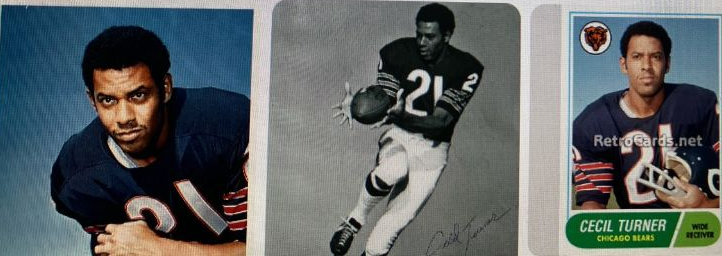
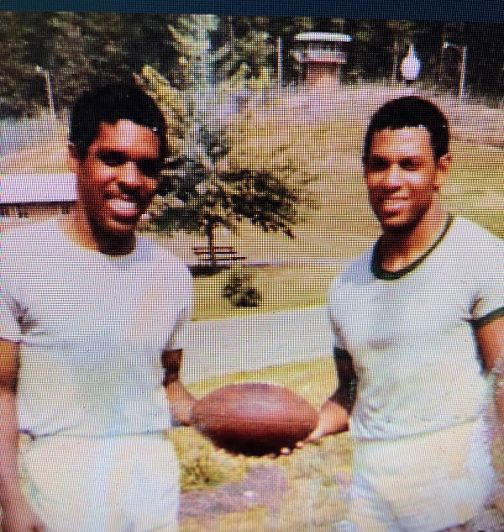
During the NFL off-season Cecil, and I would travel to Lorton Reformatory to conduct pass catching clinics for the young residents. Cecil Turner, never forgot who he was and where he came from.
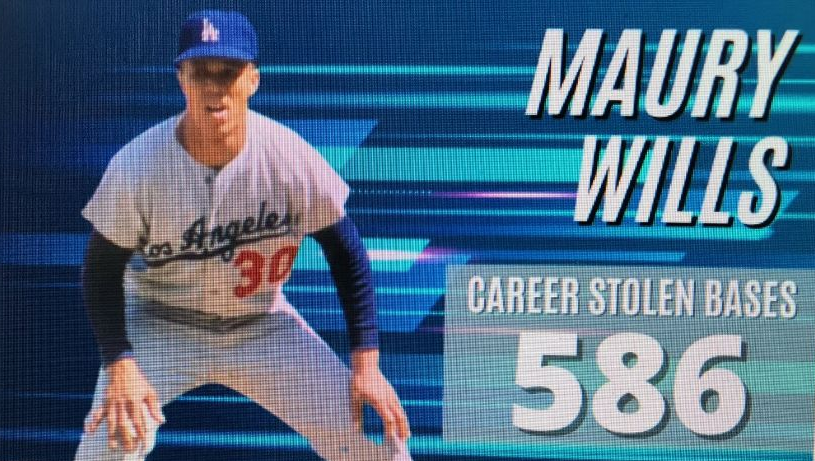
The Parkside-Mayfair community was one of Washington’s hidden athletic incubators. Long before sports academies, and year -round training programs, young people from the neighborhood were making their mark nationally. Maury Wills went on to baseball immortality. He revolutionized the stolen base in Major League Baseball. He made the home run obsolete, and he made me proud.

DC Mayor Muriel Bowser named BanNecker Field “Maury Wills Field” in October 2022
Darryl Hill broke barriers in college football, and Cecil Turner became one of the NFL’s greatest kick-off return men when he tied the Green Bay Packer’s Travis Williams with four kick-off returns for touchdowns in 1970.
Esther Stroy, a Parkside resident and Spingarn High School graduate was only 14 years old when she made the 1968 Olympic Team in Mexico City. In 2026, she is still the youngest Olympian ever.
Today, if you Google (Ai), “Harold Bell sports talk radio pioneer”, you will find my name and inside Sports as the radio and TV sports talk trailblazer in an industry now worth billions of dollars.
Our success reflects the character, discipline and competitive spirit in a community often overlooked.
Fifty-nine years later, the DC Defenders tried to capture their second straight United Football League Championship on Sunday June 13,2026.. The only other pro football team outside of the Washington Redskins to accomplish that feat were, the Virginia Sailors of the Atlanta Coast Football League.
I was a pass catching wide receiver on both of those championship teams. The DC homegrown talent all played important roles in the success of the Virginia Sailors.
While the DC Defenders and the historical Virginia Sailors both represent professional football in the Washington, D.C. area outside of the NFL, the structural design of their respective leagues is fundamentally different.
The minor league setup that Harold Bell played under in the late 1960s was built on a direct farm-system model, whereas today’s spring football landscape operates as an entirely independent entity.
1. The Atlantic Coast Football League (ACFL) vs. The United Football League (UFL)
The organizational models highlight the contrast between a traditional “farm system” and a modern “independent spring league”:
The ACFL & The Farm System Model: Operating from 1962 to 1973, the Atlantic Coast Football League was arguably the closest professional football ever came to a true “Triple-A” minor league baseball setup. Teams like the Virginia Sailors signed formal working agreements/affiliations with NFL franchises.The Sailors functioned directly as a pipeline for the Washington Redskins, regularly taking on players from Washington’s taxi squad to develop them under former Redskins player and head coach Billy Cox.
The UFL & The Spring League Model: The United Football League (formed via the XFL and USFL merger) is an independent premier spring league. It does not feature direct team-to-team affiliations with NFL franchises. While its primary goal is to showcase emerging talent and serve as a developmental platform for players aiming to make NFL rosters, the DC Defenders operate entirely under corporate league ownership rather than as a “farm club” for a specific NFL franchise.
2. Player Status and Competition Levels
The standard of play and player contracts also underscore the differences between the eras:
- The Virginia Sailors Era: Players in the ACFL were strictly minor-leaguers or NFL hopefuls working their way up. Active rosters consisted of 36 players who earned a base salary of roughly $150 per game-$350 was top of the salary scale. Despite the modest pay, the Sailors were a dominant powerhouse, capturing the ACFL championships in 1966 and 1967.
The Modern UFL Era: The UFL is a highly structured, fully professional spring league.Under the active collective bargaining agreement, players earn a minimum base salary of $6,400 per game, alongside comprehensive health insurance coverage. The rosters feature a mix of high-profile undrafted rookies, seasoned NFL veterans, and elite college talent playing a highly visible, nationally televised 10-week schedule.
1967-2026 Times Have Changed
| Feature | The Virginia Sailors (ACFL) | The DC Defenders (UFL) |
|---|---|---|
| Active Era | 1966–1968 | Present (2026) |
| League Structure | Regional minor league | National independent spring league |
| NFL Connection | Direct affiliate (Washington Redskins farm club) | Independent (De facto pipeline to all 32 NFL teams) |
| Roster Source | Local talent & Redskins taxi squad players | Drafts, regional allocations, & former NFL veterans |
| Venues | Local high school stadiums (Wakefield, George Washington) | Major professional stadiums (Audi Field) |
While my era relied on localized farm clubs to keep the pro football dream alive, the modern DC Defenders represent a highly commercialized, independent league built to sustain football fandom long after the Super Bowl concludes.

