Category: Uncategorized
JUDGE JAMES R. SPENCER: HE PROVES IT WILL NEVER BE BEYOND THE COLOR OF OUR SKIN!
Page 1 headline story in the Washington Post on Wednesday, January 7, 2015 read, “A Federal judge sentenced former Virginia Governor Robert F. McDonnell to two years in prison Tuesday–an unexpectedly lenient punishment for a man who was convicted of selling the influence of his office to a wealthy benefactor for sweetheart loans, luxury vacations and even a Rolex watch. Unless his case is overturned on appeal, McDonnell (R), who was once mentioned as a presidential contender, will become the first Virginia governor to go to prison.”
Judge James R. Spencer was the presiding judge in the historical trial of former Governor Bob McDonnell. McDonnell was facing felony charges stemming from his misuse of office. He and his wife accepted bribes from a Virginia businessman Jonnie R. Williams a wealthy dietary supplement company executive. The loans totaled $177, 000 (depending on who was counting). Spencer sentenced McDonnell to 2 years, something is wrong with this picture.
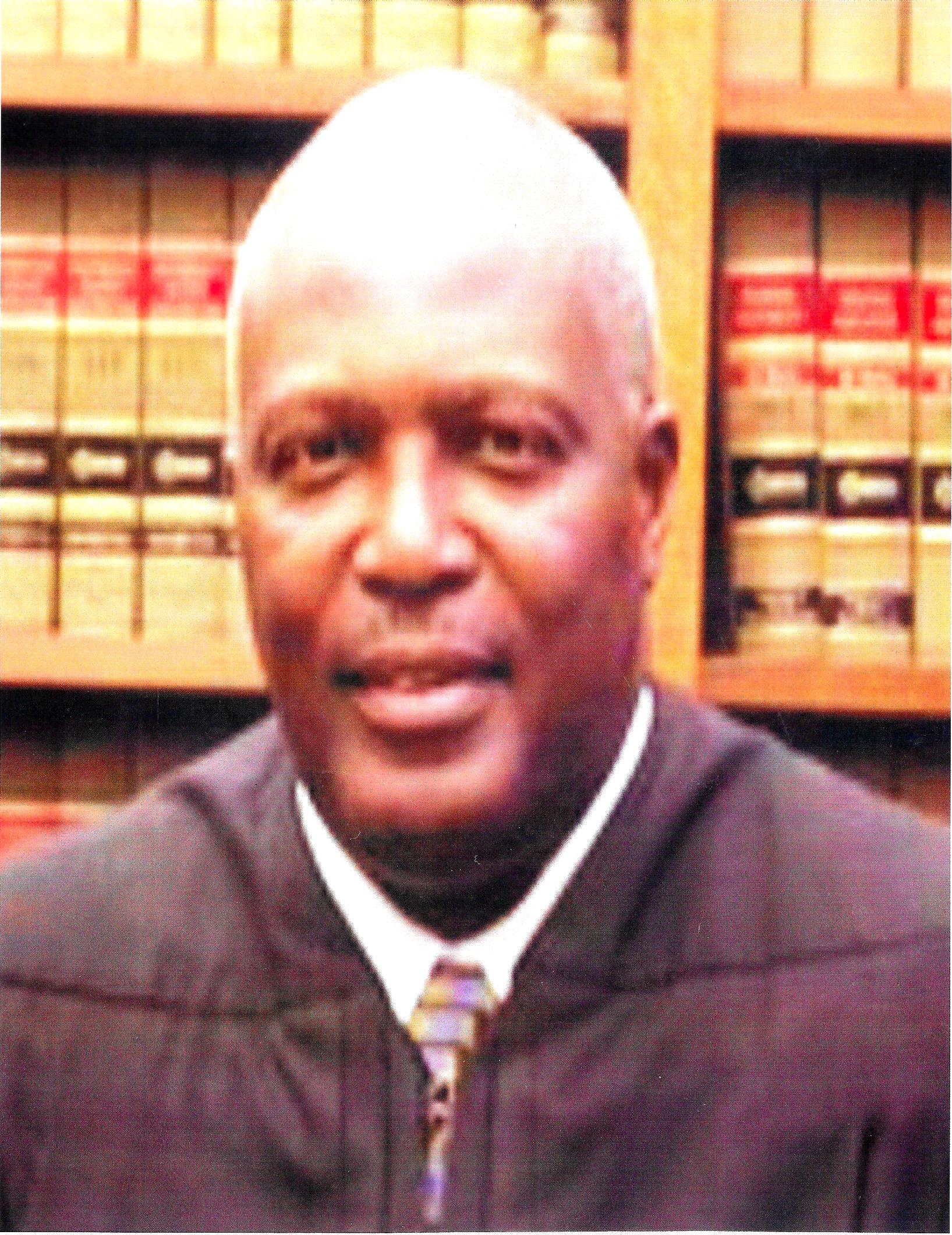
“Here Comes the Judge” took on a whole new meaning in Richmond, Virginia on January 6, 2015. It was Comedian Pigmeat Markam who coined the phrase ‘Here comes the Judge.’ He used it in his comedy routine in the 50s, 60s and 70s. U. S. Supreme Court Judge Thurgood Marshall, DC Superior Court Judge Luke C. Moore and the late “Mayor for Life” Marion Barry must have all turned over in the graves when they heard the sentence.
In the meantime, in Williamsburg, Virginia a black man was recently apprehended after stealing 3 pairs of sunglasses. The store got its merchandise back. The man was convicted in a Circuit Court (state) and he is now awaiting a sentence of up to 20 years for the theft of 3 pairs of sunglasses.
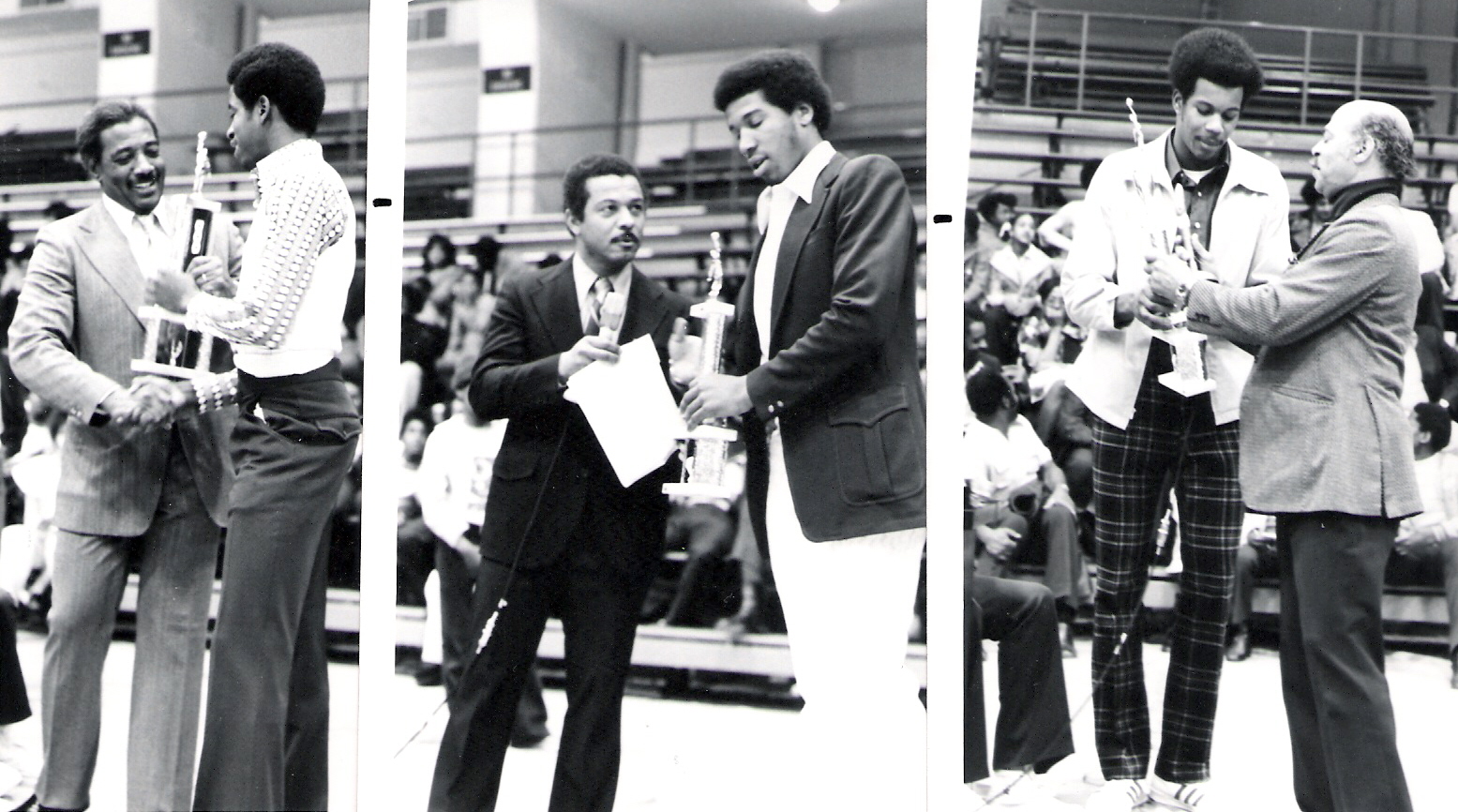

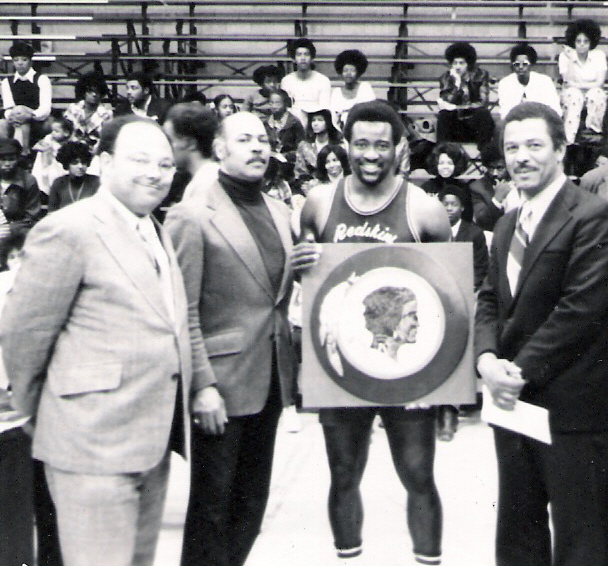
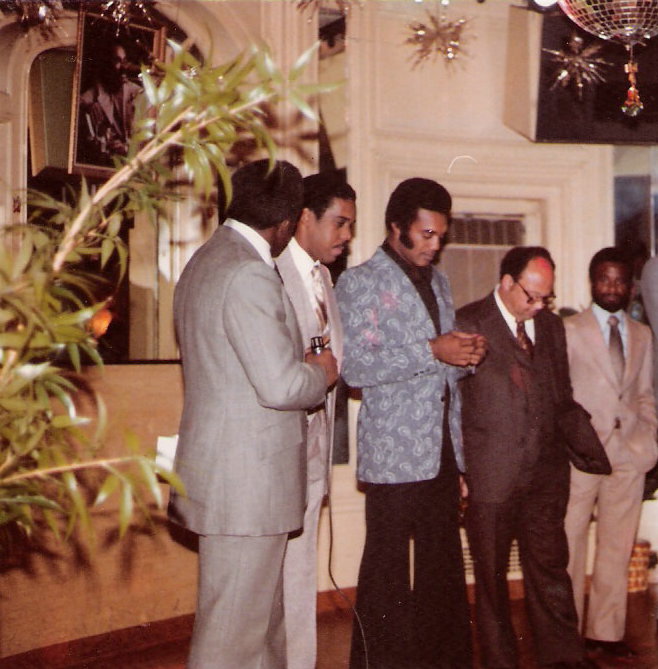
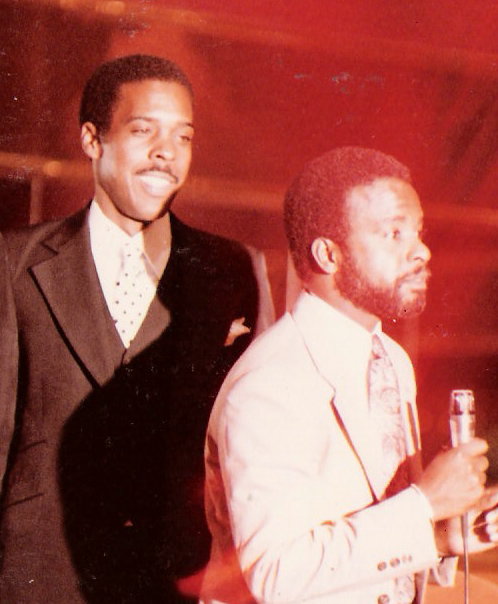
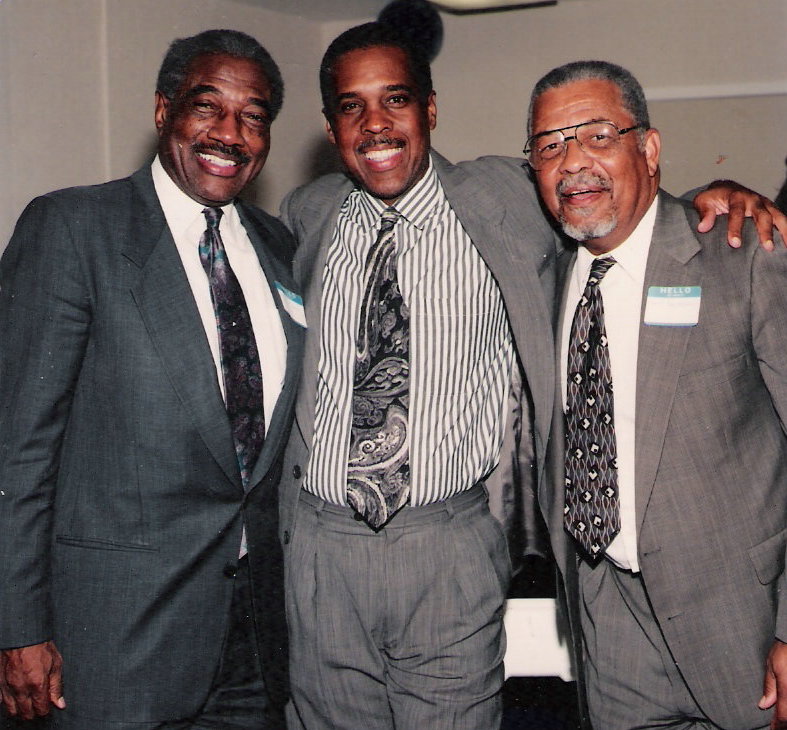
When Judges Cared: Pro athletes and DC Superior Court Judge Luke C. Moore and his colleagues reach back to support Kids In Trouble, Inc.
Top: L-R Luke C. Moore and Larry Wright (NBA), Eugene Hamilton and Adrian Dantley (NBA), Harry Alexander and Kermit Washington (NBA), Luke, HB and HB, Ted Newman, Harry T, Larry Brown (NFL) and Hamilton, Luke, HB, Roy Jefferson (NFL) Ted Newman, Henry Kennedy, Jr., HB and Kennedy, Luke, HB and Eugene Hamilton.
I first met Rev. Judge R. Spencer in 1990 at The First Baptist Church in Arlington, Virginia. He was the pulpit guest speaker. His sermon, “Role Models and Heroes.” This sermon came shortly after Marion Barry was caught on tape smoking crack cocaine in a DC hotel room with a former girl friend. Much like the game of Monopoly, Marion went straight to jail.
The sermon was one of the most powerful, I have ever heard coming out of a church pulpit.
One weekend in 1991 while I was in Richmond attending the annual CIAA Basketball Tournament, I decided to take Rev. Spencer up on his invitation to have lunch and a game of tennis. He was also a competitor on the tennis court. I kept the game close like most competitive athletes I didn’t want to bruise his ego so I won the only set we played 7-5. He walked away saying, “I will get you next time.” I loved his dialogue during our lunch on what it meant to be a black man in America, and the obstacles that lay ahead for us.
These two encounters left me totally confused and disappointed by the slap on the wrist he gave Gov. McDonnell. If you are asking the question “Why are you so confused?” First, the prosecutors recommended jail time of 10 to 12 years, and I find it very puzzling how Judge Spencer’s math, and sentencing guild lines equaled 2 years? Especially, after I had heard his “Brim and Fire Stone”, sermon as it related to ‘Heroes and Role Models.’ My meeting with him the following year in Richmond still convinced me he was the real deal.
When I heard that he was the presiding judge (a media best kept secret) I was convinced that Gov. McDonnell would serve at least 3-5 years. In my community there is an old saying, “If you cannot do the time don’t do the crime.” Evidently, Judge Spencer and I grew up on different sides of the tracks. I am sure you will also be confused if you hear his sermon in Arlington in 1990.
Judge Spencer is not the only black Federal Judge I have seen and broken bread with Up Close and Personal. My former friend and associate Alex Williams a U. S. Federal Judge is another who forgot who he was, and where he came from. His home base before he retired was the U. S. Federal Court in Greenbelt, Maryland.
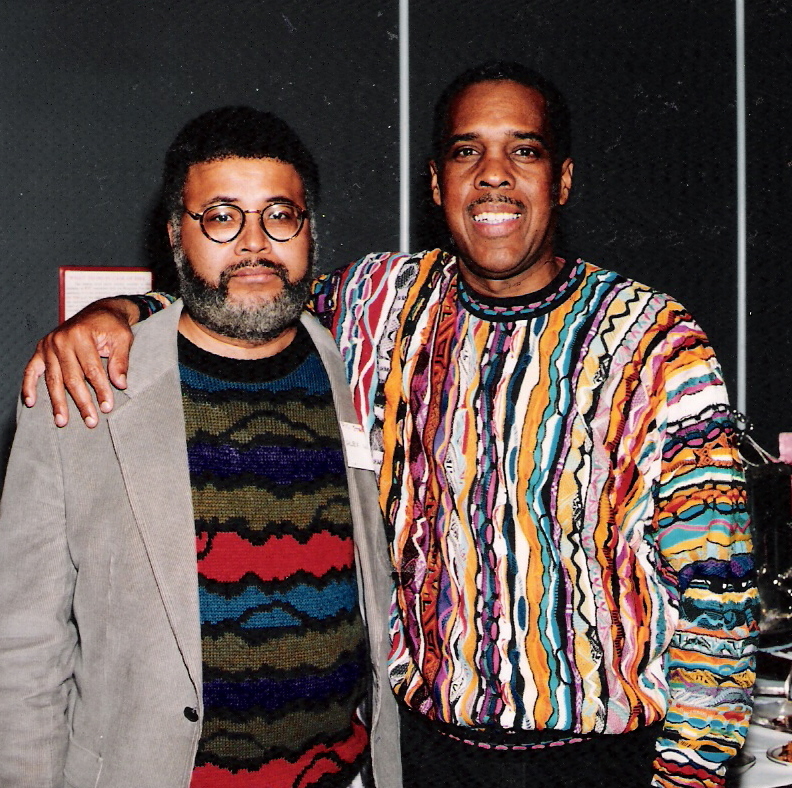
Former Federal Judge Alex Williams and my Kids In Trouble, Inc honorees tribute. Alex is standing at the piano 2nd from the right. He is being honored the Kids In Trouble, Inc. Life Achievement Award.
Alex is another benefactor of Inside Sports and Kids In Trouble, Inc. with former Judge William Missouri. Missouri was the Chief Administrate Judge of the Upper Marlboro Courthouse in the 80s and 90s. We attended Spingarn High School, we grew up in NE DC. He was known as “The Hanging Judge” in the black community in Prince Georges County. If you were black and appeared in his courtroom your goose was cooked. The two judges have served as panelist for several of my conferences on Youth Violence.
Williams’ mentor was Judge Moore and Missouri worked at the U. S. Post office with Luke, but the similarities end there. This is a sad commentary when you see black men who have become successful in the criminal justice system where they can make a difference, suddenly forget what it was once like to be black in America.
Today a Black man or woman who has to face a judge in Prince George’s County or in the DC Superior Court, and the same probably holds true in Richmond, Virginia has the deck stacked against them. Every courtroom in America has a joker in a Black Robe, and in Black Face.
Black faces may be out front in the Upper Marlboro, DC and Richmond courtrooms but there is a hint of who is in charge, the KKK aka the “Tea Party” still runs the court systems in America.
How can we forget the law enforcement person or persons who murdered the black youth Ronnie White in his jail cell in Upper Marlboro in Prince Georges County, Maryland in 2008?
This all happened on the watch of a Black State’s Attorney, a Black Chief of Police and a Black Federal Judge? White was charged with murder for fleeing the scene in a stolen car in the hit and run death of a Prince Georges County police officer. He was being held in the Prince Georges County Upper Marlboro jail waiting for his day in court when he was found hung by his neck in his protected jail cell.
This sounds like a scene out of a Mississippi jail or some backwoods city in the deep south, in the early 1900s. But no, this happen in the shadows of the Nation’s Capitol in 2008.
It is now 18 years later and the FBI, and the Justice Department on Civil Rights violations have not found the guilty party or guilty parties responsible for this hideous crime. But they have found a “Fall Guy and Scapegoat” in a black jail guard Anthony McIntosh.
McIntosh was 48 years old at the time White was found hung in his jail cell on his watch. And according to the Washington Post in a published story written February 1, 2013, McIntosh was charged with “Deprivation of rights under color of law”, a civil rights violation, in connection with White’s death at the County Detention Center in Upper Marlboro.
McIntosh allegedly found White unresponsive and didn’t get him the proper care, the Justice Department said in a news release.
According to the Washington Post, “Ronnie White was found in his cell ASPHYXIATED” (hung by his neck). The newspaper was hoping to use the word asphyxiated, and many black folks would not have a clue to how the young man died!
It has often been said “If you want to hide something from a black person put it in a book.” Their thinking, a dictionary was out of the question or reading the Washington Post.
What is the difference in the 1955 lynching of 14 year old Emit Till in Mississippi and the 2008 lynching of 24 year old Ronnie White in a Prince George’s County jail cell? Only the dates and ages have changed the color remains the same. Sixty-six years later blacks are still talking about marching?
The new updated lynching in America–being killed by a white or black cop while walking or driving black.
McIntosh was also charged with covering up his role in White’s death. He falsified an incident report and witness statement, according to the Justice Department.
The other charges include, two counts of destruction, alteration or falsification of records in a federal investigation.
McIntosh faced life in prison for the civil rights offense, authorities said, and further prison time for the others.”
On June 2, 2013 Justice & Just-Us raised its ugly head in another American courtroom——Greenbelt, Md.
Let me fast forward to an old friend and associate the presiding judge, U. S. District Court Judge Alex Williams Jr. I would like to focus on his comments during the sentencing of McIntosh. He said, “It remains unclear whether Ronnie White was murdered or took his own life.”
My question, where is the video that was suppose be taping in facilities like these—suddenly Big Brother is no longer watching? First, White’s death was correctly ruled a homicide. Later “The Good Old Boys” got their heads together and convinced the coroner to change his mind to say it also could have been suicide!
I had to take a deep breath and my heart sunk after reading Alex’s statement. The Alex Williams, I once knew, knew better, but I am willing to conceive this is not the same Alex Williams I once knew (a member of the Board of Directors of Kids In Trouble, Inc). He used my Inside Sports radio talk show to campaign for office.
I have to agree with the legendary neurosurgeon Dr. Ben Carson when he spoke several years ago at National Prayer Breakfast with President Barack Obama in attendance, he said “Whatever happen to common sense?” I would like to ask Judge Alex Williams the exact same question.
During the trial McIntosh spoke for the first time on the White hanging. He said, “I often think of how I should have done things differently, I should have been honest…no excuses.” Too little too late!
Alex tried to clean up his act later when he said, “In a county with a long history of corruption, your awful lie did broader damage, furthering a perception that there is cause for residents to be distrustful of authorities.
Law enforcement officers and correctional officers are the glue that holds society together. What has happened here is this lie. . . has inflamed and fueled the skepticism of the public that something fishy took place.” Alex, too late the damage has already been done.
My Interpretation of McIntosh’s response to Judge Williams; “With this payout I can do 2 years standing on my head.” Checkout his release, and follow the Yellow Brick Road to a life of leisure and comfort.
White’s family members used the courtroom to go further, saying they still believe White’s death was vigilante justice.
White’s mother, and stepfather said in court that they did not accept the explanation that White committed suicide. Lonnie Gray, White’s stepfather, said, “I think the county police killed Ronnie.” He called McIntosh a ‘scapegoat’ in a larger conspiracy.
Alex’s response, “I cannot blame Mr. Gray for the accusation.”
“The father, the family, is expressing the view that is out there that something occurred that has never been resolved, adding that he, himself, is not sure. No one clearly knows whether the death was a suicide or a homicide.”
Alex sounds like the Trayvon Martin jury “The killers were only standing their ground.”
The family has been paid off, McIntosh has been paid off and Alex??? This is a very scary situation for Prince Georges County residents in 2026, and beyond. The county is fast becoming a ‘Police State.’ Alex and his gated-community neighbors don’t have to live in fear so far, but it is coming to his neighborhood sooner than he thinks.
According to the Justice Department the Ronnie White case is now closed, and they will not look any further for his murders. When is a murder case ever closed?
Add to Alex’s slap on the wrist to McIntosh, this now means that Prince Georges County residents are playing Russian roulette with their lives every time they leave home. You will never know when the next Prince Georges County cop car pulls you over and behind the wheel sits one of Ronnie White’s killers.
There are police officers in PG County who will say that Ronnie White was murdered, but only off the record.
My brother Earl a former DC cop, and I talked about this case before he died and he said, “The cops hung that brother.” As we read the outcome and verdict in the Washington Post, he said “What did you expect?” I expected better because my friend Alex Williams was the judge on record—but what did I know and when did I not know it?
Remember, the Washington Post in an early report said, “McIntosh faces additional charges for the civil rights offense, and can get life in prison”, authorities said.” How did we get life in prison down to 2 years? Alex missed an opportunity to send a message to the Fraternal Order of Police and their kind but instead he went along to get along.
The same Justice and vigilante acts that have been a part of Prince Georges County for decades are still in play and now with black faces in leadership positions, it has gotten worst instead of better (Plantation Mentality).
If you don’t think the Plantation Mentality still exist, just ask Congresswoman Eleanor Holmes Norton (D-DC), and the residents living in the Nation’s Capitol of Washington, DC. They still have no rights that a white man has to respect!
Clarence Thomas, Spencer, Williams and Missouri all benefited from the Civil Rights movement but it seems like they have forgotten.
The Prince George’s County Police Chief Melvin High retired during the murder investigation but re-surfaced as a candidate for the Prince Georges’ County Sheriff’s Office! He runs away from doing his job as the Chief of Police but is voted back into a similar job as Chief in the Sheriff’s Office in the same county. His PR person Barbra Hamm saw what was ahead. She left the department before total chaos, and went back home to Norfolk, Virginia. We cannot blame Chief High or white folks in what is called the most affluent black county in the United States. Once again, “What ever happen to common sense?”
Glenn Ivey the State’s Attorney didn’t have a clue when he took the office. I met Ivey at a Minister’s Prayer Breakfast shortly after I had written a column in the Washington Post questioning his and Chief High’s investigation tactics, and lack of involvement into youth violence at nearby Suitland High School. The school was then known as “The Black Board Jungle” of the school system.
Ivey took offense to my commentary but agreed to meet with me and other community advocates in his Upper Marlboro Office to discuss solutions. I invited members of the clergy, ex-law enforcement officers, ex-cons and other well known community advocates to the meeting.
We spent several hours tring to come up with some solutions to youth violence in our community. To make a long story short, the meeting was a waste of our time. Ivey had surrounded himself with a staff that was as clueless as himself—it was the blind leading the blind.
There have been several senseless murders at Suitland High School since I last met with Glenn Ivey. He was a total disaster and has since retired but thanks to him and his kind the beat goes on. The violence continues in our schools and community.
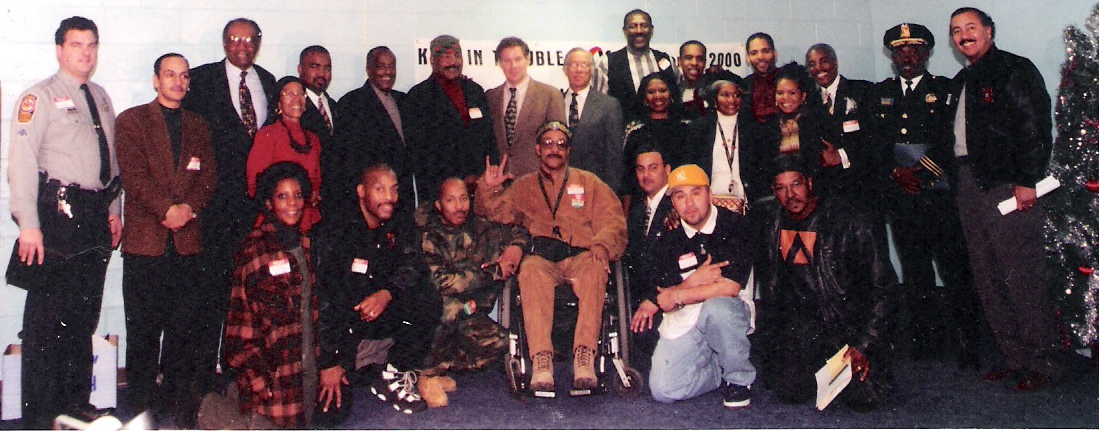
Kids In Trouble,Inc. Youth Violence Conference in Washington, DC in 1995. Co-Chairs, Jim Brown (NFL) and Congressman Tom Davis (R-Vir). Gang members and crews from the east coast and as far away as the west coast were in attendance. Davis was just another politician looking for a photo opportunity with Jim Brown. After the the forum Davis disappeared without a trace.
One of the reasons Justice has become so elusive and its Just-Us in America’s courtrooms, it is because the Black jurist sitting on the bench have forgotten who they are and where they came from. Judge James R. Spencer is just the latest. They are so busy trying to play fair but fail to realize that black folks are the only ones playing fair.
The wake-up call should have been when the Supreme Court passed a bill saying, “Donors to political campaigns can give unlimited amounts of cash to their favorite politicians.” Does that Supreme Court act sound like or spell F-A-I-R? How can that be fair when 1% of the country controls all the wealth, and now they will continue to control the office of the President and the House and the Senate.
Before his appointment to the bench Judge Luke C. Moore was the first black since Reconstruction to head the U. S. Marshall Service (President Lyndon Baines Johnson). Shakespeare once said “Kill all the lawyers,” I now understand his shout out, but Judge Luke Moore and Thurgood Marshall were, ‘The Gate Keepers.’
Justice in most American courts and Grand Jury rooms still seem to lean in the direction of Just-Us when it comes to people of color. Most of the good lawyers/jurist I know are dead, Thurgood Marshall, Johnnie Cochran, Luke C. Moore, Harry T. Alexander, Kenneth Munday, Warren Copeland and Charlie Schultz.
Mr. Schultz drowned in a swimming accident in Florida trying to save a child. He died trying to help someone else, which was reflective of his courtroom demeanor.
Despite Barack Obama residence at 1600 Pennsylvania Avenue as the country’s first Black President racism is alive and well in America. The American Court system is still one racist main thoroughfare. Black men are being jailed, and murdered in record numbers. America houses more prisoners than anyone else in the world. Prisons are big business, and are on the Wall Street stock market–men of color are it biggest commodity.
The latest outcry in police departments around this country of “Us Against Them” is ridiculous. Blaming New York Mayor Bill de Blasio for the death of 2 New York City police officers ambushed in their patrol car is a cope out. This is nothing but a smoke screen for the embedded racism found in departments across America. They are hiding behind a Code of Silence and The Blue Wall that protects crooked and corrupt cops.
Eric Holder the U. S. Attorney General was right on the one at a Black History Month tribute at the Justice Department, he said, “We have become a country of cowards!”
I am out of a cop family, 2 of 3 of my brothers served. My older brother Bobby was a U. S. Marshall for 20 years and my younger brother Earl was a DC cop for 14 years before he became a victim of The Code of Silence! I have spent 50 years working in the inner-city with youth gangs and at-risk children and I have seen the Good, Bad and Ugly when it comes to law enforcement.
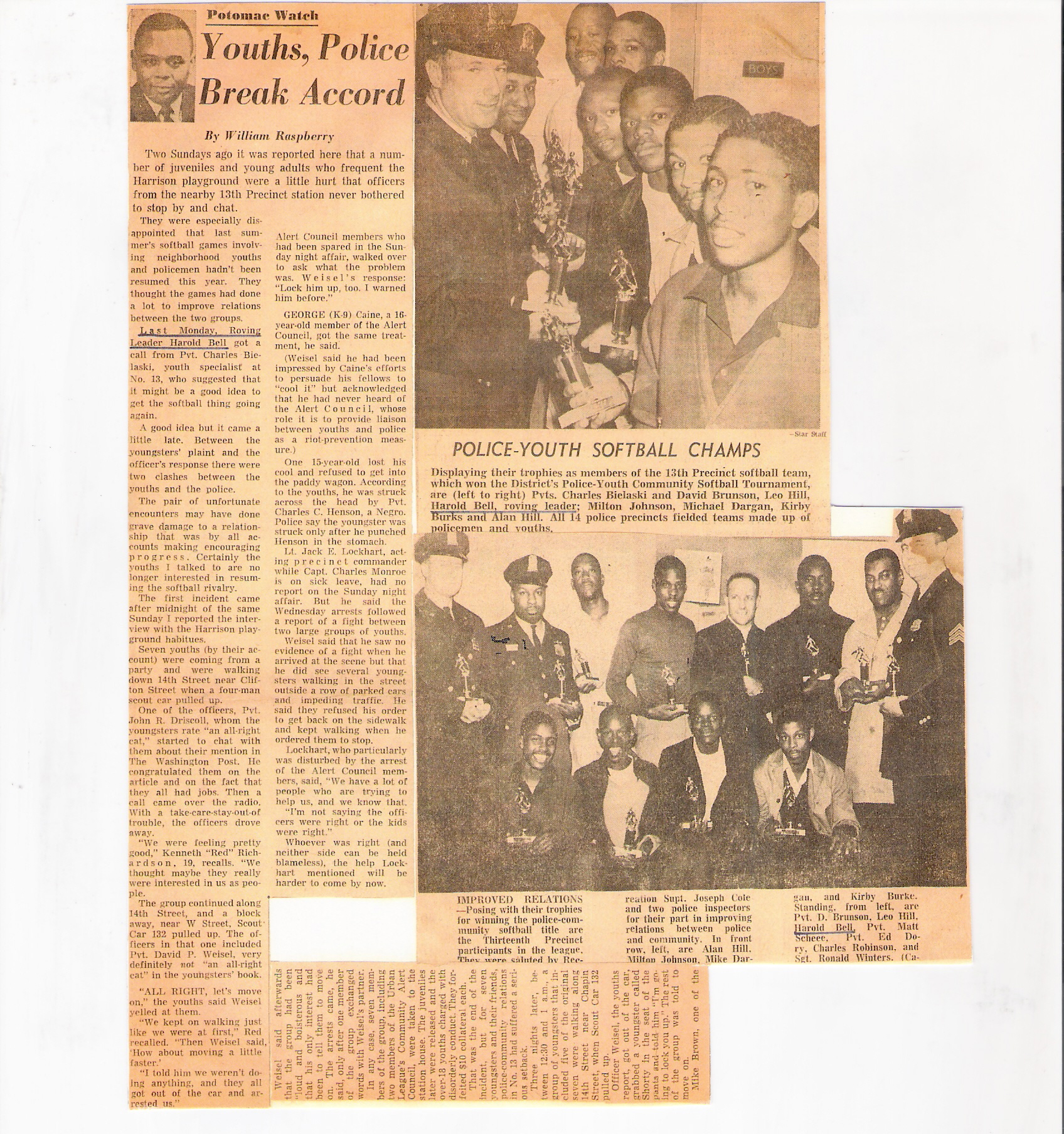
Washington Post columnist and Pulitzer Prize winner Bill Raspberry examines Police Community Relations efforts in DC. He takes a look at the non-profit organization Kids In Trouble, Inc. in the Cardozo U Street corridor in the 60s and 70s. He found it was the police that strayed, and not the community.
There are some good cops out there trying to do the right thing but they are outnumbered by the cowards and bullies. Cameras are just a part of the answer. They will only slow down the corrupt and crooked cops for a minute.
The answer, change the mentality of law enforcement, especially, the Chief of the Wisconsin, Milwaukee Sheriff’s Department, David Clark. He is in need of a crash course not only in Black History but American History. I found his interview with CNN’s Brooks Baldwin on Tuesday January 6, 2015 not only disturbing but also embarrassing.
In 1967 President Lyndon Johnson commissioned, The Kerner Report, the panel was to study why was there was so much unrest among urban cities in America. The panel’s conclusion, “The country was headed in the direction of two Americas, one Black and one White.”
As we head into 2026 the Republicans and Democrats with a little help from the likes of David Clark have made that prediction a reality.
In 1970 I found the first ever half-way house established for juvenile delinquents on a military installation on Bolling Air Force Base in DC. Chief Judge Harold Green and Judges Harry T. Alexander and Luke C. Moore were in attendance to cut the ribbon for this historical moment. Judges putting their mouths where their money was, back in the community.
One of the most impressive things to me about the judges of the DC Superior Court back in the day was when they gave you their word, you could carry it to the bank.
Judges Moore and Alexander’s community involvement attracted other judges, athletes and media personalities to encourage the growth of inner-city children .
This is a sad commentary because Black Judges like James Spencer and Alex Williams stand on the shoulders of men like Thurgood Marshall and Luke C. Moore. If I had to walk down a dark alley in one of the worst crime ridden sections of DC, it would be NE Trinidad. And I there was a need for someone to protect my back and I had my choices Judges to select between, Spencer, Missouri, Williams and Supreme Court Justice Clarence Thomas. My choice would be Thomas. At least he has been honest and up front as it relates to his position on his racial preferences and his state of mind as it relates to racial progress in America . The others have played both sides of the fence, jumping to one side or the other when it enhanced their agendas. They have gone along to get along, and that is the problem in our community–no one takes a stand for what is right.
Can you imagine what the black man sitting in that jail cell in Williamsburg is saying to himself tonight, while awaiting a sentence of up to 20 years for stealing 3 pairs of sunglasses? How about, “Judge Spencer can you give a brother a little help?”
Pastor John Jenkins and First Baptist Church of Glenn Arden, Maryland was scheduled to have a Town Hall Meeting titled “Beyond the Color of Our Skin.” They must be kidding, it is never going to be beyond the color of our skin in America in our life time.
It is often said, “Justice is Blind” so is the leadership in our courtrooms Monday through Friday, in our Pulpits on Sunday mornings to the close business on Capitol Hill on the weekends, and a media pressroom at Deadline. The problem–we are still looking for love in all the wrong places.
DONALD STERLING AND THE NBA RACE CARD: WHO IS ZOOMING WHO?
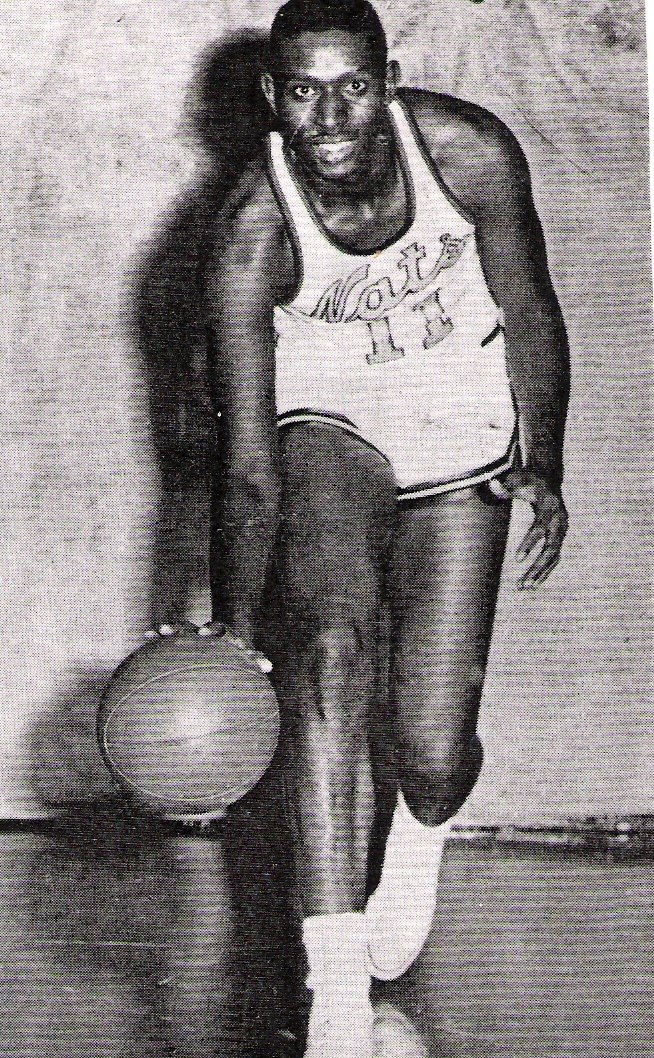
 Earl Lloyd the first black to play in the NBA .
My media association started with the NBA in 1971 I have seen the Good, Bad and Ugly and sometimes that are one of the same. My relationship with the NBA got off to a rocky start. In the late 70s my media mentor Sonny Hill invited me to attend the NBA All-Star Game in Houston, Texas. He then explained to me the proper procedure for requesting press credentials. I called the league office and got the mailing address to request credentials and filed a request. When Sonny and I arrived in Houston we checked into our hotel room. Our next stop would be the press media room to pick-up our credentials. There we would find the man in charge of the credential process, Mr. Brian McIntyre. He was sitting almost alone and there was no one waiting in line (compared to today’s media circus). Sonny introduced me and picked up his credentials. But Mr. McIntyre could not find my request and refused to issue me credentials. I pleaded with him for understanding; as why would I fly all the way to Houston from DC and make up a story about credentials? He would not budge. I stood there for almost 30 minutes watching media types pick-up their credentials. It finally hit me I had an “Ace in the hole” NBA legend Red Auerbach. The next break at the press credential table I asked Mr. McIntyre if he knew Red Auerbach? His response, ‘Yes do you?’ I then asked for permission to use his phone, request granted. I remembered my last conversation with Red, he said he would not be coming out for the game. I knew Red and Dotie’s number by heart and I called their residence. The voice answering the phone would be Dotie. I asked for Red and she told me he was out at Woodmont Country club Playing cards. I would guess she heard the urgency in my voice and asked me if everything was all right? I explained to her that I was in Houston for the NBA All-Star Game and I was having a problem getting press credentials. She asked to speak to Mr. McIntyre. The two spoke for a couple of minutes. He hung up the phone and said “No problem!” The Bad But It would be a problem in the Bullets/Wizards press rooms. It was here I would encounter “The Media Relations Directors from Hell!” There were no minorities in charge of media relations during that era. I remember when me and a white sports writer by the name of Frank Pastor decided to integrate the Bullets press table in 1974. Frank and I were just returning back to our seats from a half-time break. We were waiting at the top of the arena for a break in the action. I looked down and notice that all the white media were seated on one side of half-court and all the blacks were seated on the other side of the half-court line. I mentioned my observation to Frank and without hesitation he said “I am going to sit in your seat and you sit in mine.” We quietly integrated the media press table without a police escort or an angry word. But everyone was not overjoyed about the new pecking order. Mark Splaver was the man in charge of the Bullet press table and he was not a happy camper. The very next game I discovered how unhappy he was. I arrived at my seat a little late but I noticed that members of the media had been issued new media guilds, but there was none at my seat. I found Mark to tell him about the oversight and he just looked at me and walked away without a word. I returned to my seat. Jerry Sachs was the Bullet’s President and he was a class act. He would usually be seated at floor level near the press table. We often shook hands and exchanged words as I walked by. This time he asked me was everything all right? My response “I am fine Mr. Sachs.” In less then 10 minutes Mark came back to the press table and tossed the media guild on the table in front of me and walk away. This was unacceptable and I got up to follow him and evidently Mr. Sachs had watched the whole episode unfold. He stepped in front of me and said “I got it.” It would be the start of the 4th quarter that Mark returned to the press table table and apologize for his unprofessional actions. I accepted his apology. In 1980 I was named “Washingtonian of the Year” Jerry was one of the first to mail me a personally hand written note congratulating me and Hymie called me and cussed me out and warned me not to get too big for my britches —the congratulations carried different messages but one of the same, respect. The Good Bullet players Phil Chenier, Larry Wright, Carlos Terry, Greg Ballard, Coaches, KC Jones and Bernie Bickerstaff and front office types like GM Bob Ferry and Bob Zurflu all supported my community endeavors (Celebrity Tennis & Fashion Shows).
The Bad press relations with blacks in media continued at the Verizon Center. There were other mistakes like someone thought a black Judy Holland was VP material—far from it. Her media relations project was player Rick McHorn. I spoke with Mr. McIntyre at the NBA All-Star Game in Philadelphia over 2 decades ago about minority problems in gaining access to NBA press tables as it related to the Bullets/Wizards. He suggested we meet for lunch and discuss the matter. It took a minute but in the meantime, he was making an effort to bring about change in his own way. But according veteran (32 years) sports writer Bill Rhoden of the New York Times, progress in sports media pressrooms around the country are on a slow boat to China. His recent appearance on the widely acclaimed television news show Meet the Press, he said, “the NBA, NFL and MLB are still dragging their feet. In my travels there are media press rooms I go in where I am still the only black face in 2014!” That is a sad commentary, but what I suspected all along. Media press rooms at Deadline are still the last plantations. Pioneering broadcaster and former NBA CBS basketball analyst Sonny Hill and now a sports talk show host on WIP Radio in Philadelphia said, “I am not surprised by Rhoden’s statement, very little has changed in media pressrooms. One of the problems there is no networking among blacks who have moved it up the ladder.” That is an understatement. Rhoden was a regular on The Inside Sports Media Roundtable long before he appeared on ESPN’s Sports Reporters and Meet the Press. The Ugly In 1978 a writer in the Style section of the Washington Post conspired with several of his colleagues and took my show title “Inside Sports” to New York City. In 1979 he found and published Inside Sports Magazine. He is now the VP of ESPN television, his name is John Walsh. The copy rights for Inside Sports is own by News Week Magazine and it is own by the Washington Post. The beat goes on! I have been in the sports media for 45 years. I was still having problems gaining access, of all places at the Verizon Center. First, there was a a problem with the PR Men from hell, Brian Sereno and Matt Williams. It was brought to my attention that Sereno was disrespecting the ladies of The Roundball Report. He had called co-host Christy Winters-Scott a liar over something trivia. Andrew Dyer the Executive Producer of the show asked me if I would intervene and I did. He thought there was a double standard. The Roundball Report aired on PG Cable 76 (is strictly a basketball show). I e-mailed Sereno and asked for a meeting. The meeting was set before a Wizard’s game in the press louge but Scott Hall was the lead man. Scott was a breath of fresh air. He listened and we disagreed on some points but when we walked away from the table we were on the same page. The next thing I knew Brian was gone and Matt Williams had replaced him. Williams had an ego that was as big as he was. He not only alienated members of the the media but people in his own department. He was soon gone without a trace. Christy Winters-Scott has since moved on and she is now a studio co-host for Comcast Sports another media plantation. It is very difficult to see and understand perceived slights (racism) if you have not walked in the other person’s shoes. Enter, Scott Hall Scott’s willingness to discuss what was thought to be a problem has since become a lesson of what can happen when folks can sit down and talk. I will bet his staff is one of the most diverse in the NBA (I could be wrong). The problem with racism people are scared and uncomfortable talking about it (to include blacks). The Good The Washington Bullets’ home was the Capitol Centre in Landover, Maryland. Hymie Perlo was and still is irreplacable. His presense is still missed today. His heart was as big as the arena that he worked in. He was the best PR man in the NBA bar none. The community and everyone in it was a friend, the old and the young, the black and the white and the healthy and the lame. Hymie was a jewel of a man. I was honored to speak at his retirement held at the arena just before the Bullets moved to Washington and changed their name to the Wizards. Denny Gordon was in ticket sales and it seem like he knew everyone who brought a ticket. He loved his job and Bullet ticket holders loved him. I look around and the holdovers from Landover in 1978 are far, few and in between. There is Dolph, Arnie, and Paul still on staff. Phil Chenier is on the broadcast team and Kenny Burns is a Supervisor in security. The Ugly In 1975 Bullets coach KC Jones was fired by owner Abe Polin after losing in the NBA finals to the Golden State Warriors in 4 straight games. He was made the scapegoat after being sold out by his assisstant coach Bernie Bickerstaff and others. Bickerstaff was rewarded when he landed a job with the new Bullet coach Dick Motta. KC was and is a class act. He is one of the nicest men in pro sports. 1977 I was a Nike rep when Nike NBA rep John Phillips invited me to meet him in the NBA Office in New York City. The meeting revolved around a charity all-star game scheduled for the Bahamas, the island home of NBA star Mycal Thompson. The game had been played the year before without incident or controversy. Magic Johnson was one of All-Stars participating. Representatives from the NBA included VP Ron Thorne, Legal Counsel Gary Bettman and head of security Horace Balmer. John and I were in for a shocking revelation. Bettman claimed the game could not go on as planned because the NBA own the players. We could not believe our ears. My response was, “Are you saying this is a plantation?” The room went silent, Thorne called the meeting off and said he would call us later, but he never did. Magic disappeared and changed his telephone number. Gary Bettman is the Commissioner of the NHL, Thorne is somewhere lurking in the NBA, Balmer has since retired and Magic is a role model for Black America? The short lived existence of basketball legend Michael Jordan as a Wizard’s player and Executive in the front office. His dismissal from the team by owner Abe Polin was a sad day for many. In December 2009 Gilbert Arenas brought a handgun into the Wizards locker room. After the story broke he and several teammates made light of it during introductions of a game. He was eventually suspended for most of the 2009–10 season. The thing that I find disturbing about this Donald Sterling charade is that folks are acting like they were surprised by his rants against blacks. I also notice the same “Old faces and voices” are called on to respond to the racist acts by men like Sterling—when they are a part of the problem . Faces and voices that I am familiar with like Magic Johnson. He and Sterling were good friends because “Birds of a feather flock together.” Check Magic’s history out and you will discover the two have a lot in common. Magic’s claim to be a minority owner of the LA Dodgers is another sham (token black face). I know for a fact he was anything but a victim. Rev. James Brown (CBS Sports) another misguided brother claiming to be a minority baseball owner and an expert on racism. He did finally admit on the late George Michael Show (Sports Machine) “I have no say in making baseball decisions as a minority owner.” His role as a minority owner is to be paraded out on Opening Day as the black face to read the starting line-ups. Come on man! ESPN’s Michael Wilbon, was front and center as an expert on racism in America with ABC’s Diane Sawyer. This is the same Michael Wilbon that I had at least two recent conversations about the use of the N word as a term of endearment. I have to give him credit, he will at least talk to me face to face and not behind my back. I tried to explain that his rationale that his grandfather’s use the word as a term of endearment does not make it right today. I told him he should not go on national television saying it is okay to use the N word among friends and family. It gives bigots like Donald Sterling the Green Light to do the same among his friends and family. Plus, Michael told me he was not going to appear on the ESPN Show Outside the Lines because the white host had no horse in the race! Two weeks later I turn on the television and there he is front and center. I wish that Magic, James, Michael and the rest of the media experts would defer to black men like Hank Aaron, Dr. Harry Edwards and even Jim Brown and Bill Russell. Brown and Russell sometimes talk out of both sides of their mouths. But they wear the battle scars and have been on the front lines of the civil rights movement in real life and in the sports arenas of America. In other words, they have been there and done that. I guess that is wishful thinking, especially when everyone wants to be an expert on television. In the meantime, they don’t know their asses from a hole in the ground but the beat goes on and on. In 1964, Red was the first coach to play the first-ever black NBA starting five. They were Bill Russell, Willie Naulls, Satch Sanders, Sam Jones, and K. C. Jones. Auerbach would go a step further in the 1966-67 NBA season, when he stepped down after winning nine titles in 11 years, and made Bill Russell player-coach. Russell would eventually be the first black to win an NBA championship. He would later be named the NBA’s first black General Manager. It was Red Auerbach and Walter Brown who not only talked the talk but walked the walk. They led the way against all odds.
Fast-forward to April 2014, how was it that Donald Sterling’s racist actions against minorities went undetected under the NBA radar for decades?
First, Sterling belongs to the exclusive 1% club of billionaires in America. He does not need to wear the traditional KKK robe to be a member in good standing. There are far too many crying “Foul” and playing the victims in this charade, to include some NBA owners.
Let me start with my homeboy, the great Elgin Baylor who was the Clippers GM for over 2 decades. His teams were perennial losers on the court and in attendance, but he picked up his check every two weeks and kept his mouth shut. Elgin lived by the premise “You don’t bite the hand that feeds you.”
Elgin finally cried “Foul” when Sterling fired him. He carried his former boss to court in 2010. He filed a wrongful termination and sued Sterling for racism.
In his deposition, Elgin spoke about what he called Sterling’s ‘plantation mentality,’ alleging the owner in the late 1990s rejected a coaching candidate, Jim Brewer, because of race. Baylor quoted Sterling as saying: ‘Personally, I would like to have a white Southern coach coaching my poor black players.’ He dropped the racism from the suit. The case was thrown out of court in 2011.
The other entity to cry foul and caught with their hands in “The cookie jar” was the local branch of the Los Angeles NAACP (The National Association for the Advancement of Colored People). Talking about an organization needing a change of name and a face-lift—meet Leon Jenkins.
Jenkins seen above at a press conference trying to explain why the local branch was honoring Sterling during the 100th Anniversary of the organization next month. He explained the previous award had been approved by the man he replaced and he just went along to get along. But this time he was on the hot seat for approving the second award in May. Jenkin’s excuse for not cutting ties with Sterling was lame at best. He said “We were reluctant to make decisions based on rumors!” We deal with the actual character of the person as we see it and as it is displayed.” This is another example of the blind leading the blind all that Jenkins could see was “Show me the money.” The taped revealed exactly how Sterling felt about black people, including his good friend Magic Johnson. He had his fingers in Magic’s eyes and his foot in his butt at the same time. Sterling won’t be the first to sleep black and think white when it comes to sex, politics and money. Slave owners lived by the credo and in modern day history there was the late Senator Strom Thurmond. The plantation mentality is just a board meeting away. I will always remember a meeting in the NBA League Office in 1978. Nike NBA rep John Phillips and I met with VP Rod Thorn, League Counsel Gary Bettman and Head of League Security, Horace Balmer. The meeting centered around whether Magic Johnson, Mycal Thompson and a group of NBA All-Stars would be allowed to travel to the Bahamas for a charity basketball game without league approval. The game had been played in the Bahamas the previous year without incident or controversy. It was obvious that there was a power-play being made by the league office to cancel the game. Thorn open the meeting by asking who was going to be responsible if one of the players was hurt during the game? John’s response, “Each player has his own insurance policy.” Bettman response, “You cannot assume that each player has insurance and you cannot go forward with this game without the league’s permission.” John and I had met with Magic and Mycal before the meeting and had given them a heads up. They both were still ready to participate. Magic suggested that the topic of conversation just might be centered around an injury to a player. He was right on point. To this day I think Magic had a previous discussion with the league office. I responded to Thorn’s concern because it was legit. I tried to explain that playing the game was no different then one of the players participating in a pick-up game on a New York City playground in the off season. In fact they would be safer playing in the Bahamas among their peers. The risk of injury was minimum. Before Thorn could respond to me Bettman blurted out “You cannot do that we own them.” John looked at me as if to say ‘I cannot believe he just said that.’ My response to Bettman, “What do you mean you own them. What is this some kind of plantation?” The room went silent and Horace Balmer the only other black in the room just shook his head and seem to be lost for words. The meeting went downhill from there. Thorn called off the discussion and promised to get back to us but he never did. In the meantime, Magic Johnson disappeared and changed his number. John Phillips met with Mycal Thompson and cancelled the game. Mycal was a class act but his hands were tied when Magic decided to do his Houdini act. Gary Bettman now runs the NHL, Ron Thorn is still in the NBA somewhere calling the shots, Horace Balmer has since retired and Magic is the face (black) in the middle of the Donald Sterling charade. The Race Card is front and center. When all is said and done, the real victim despite all of her baggage is the girlfriend (The Whistle Blower) V. Stiviano. NBA Commissioner Adam Silver during his annoucement as it related to the punishment of Donald Sterling apologize to black NBA pioneers Earl Lloyd, Chuck Cooper and Magic Johnson. But forgot to thank V. Stiviano??? I am betting Magic Johnson and his NBA counter-parts throw her under the bus—-stay tune.
40 YEARS LATER THE GREATEST IS STILL THE GREATEST!
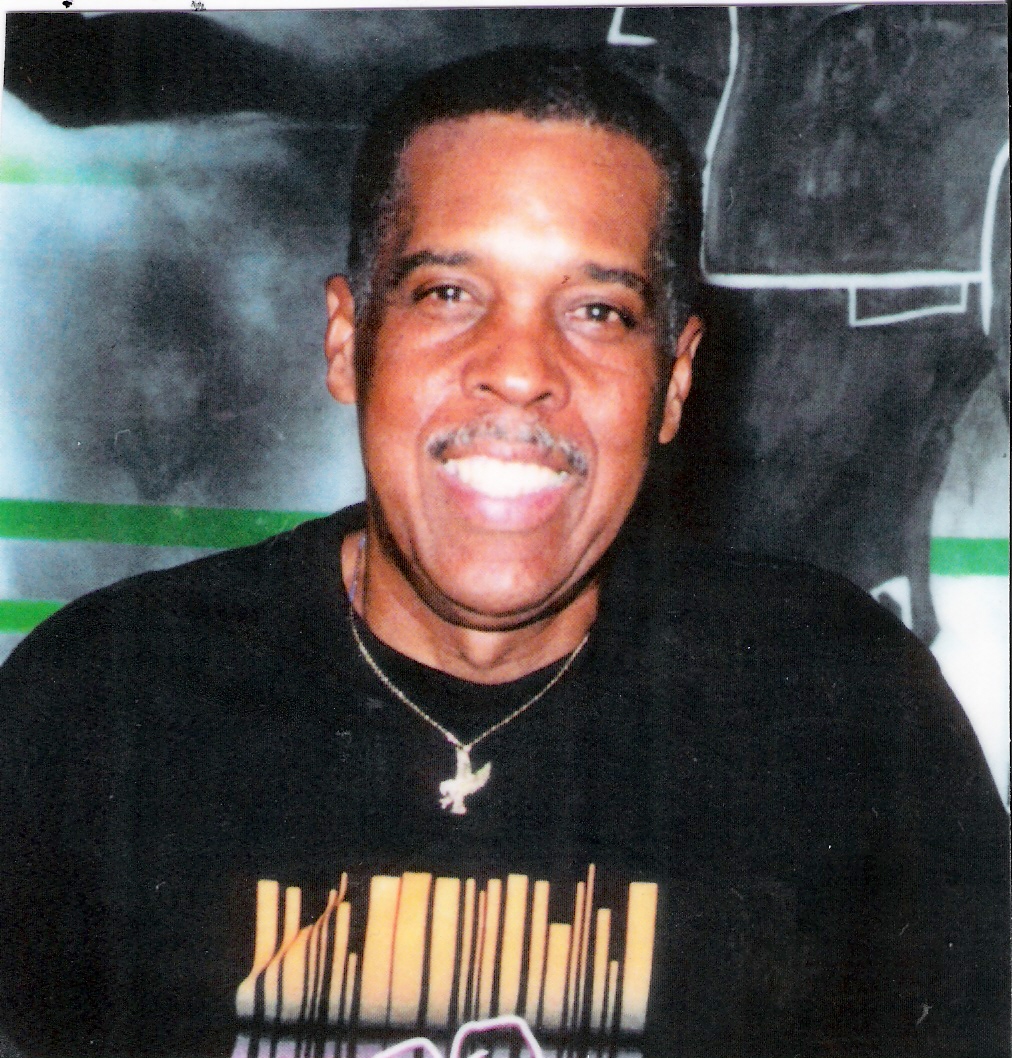
Harold Bell (Inside Sports)
Ali shocked the sports world on October 30, 1974 when he knocked out George Foreman in the 8th round in a fight known as The Rumble in the Jungle.
The Dope he roped was none other then the Heavyweight Champion of the world. Big George would later admit “Ali out thought me and he outfought me.”
Ali and I met in Chicago prior to the big fight. He invited me to go as his guest. I turned down his invitation I was not too thrilled about flying across all that water. A decision I now regret.
But he promised me on his return back to the United States I would be the first media personality to interview him in New York City. I never will forget how confident he was that he would return victorious.
The champ was a man of his word. He called me after his arrival back home and gave me the green light to head on up to the Big Apple. The interview was held in his hotel room overlooking Central Park.
My producer Rodney Brown and cameraman Wil Williams would accompany me on this historical journey. On our arrival in the hotel lobby I called the room number he had given me. He answered the phone and said, “Come on up!” He opened the door while combing his hair and said “What I tell you boy, I am the Greatest.” We all started laughing–he was right again.
In the best interview I have ever seen Ali give. He talks about controversy, friendship, truth, the innocent of a little child, the difference between a boxer and a fighter, The White House and self-sufficency. He closes the show talking about his commitment to the Nation of Islam.
The interview is captured in the video titled, “The Legends of Inside Sports.” Its one of a kind. This is the Greatest being the Greatest as he talks about The Game Called Life. Forty years later the topics are still revelant.
The interview is one of a kind there is nothing like it in the market place. In 2007 a group brought the rights to Ali’s name and likeness for 50 million dollars and 20% of the monies generated from advertising. It was a great deal for the champ because of his age and failing health.
My interview is distinguished by his left black eye and it was not for sale. The champ never allows anyone to interview him with marks on his pretty face. If you ever see any parts of my interview with Ali and he has a black eye–you will know it is my interview with the champ in November of 1974. The interview made its debut on NBC affiliate WRC-TV 4 in Washington, DC in November 1975. It has not been seen since. I have the copy rights to the entire interview. Stay tune.
NO CHEERING IN THE PRESS BOX!
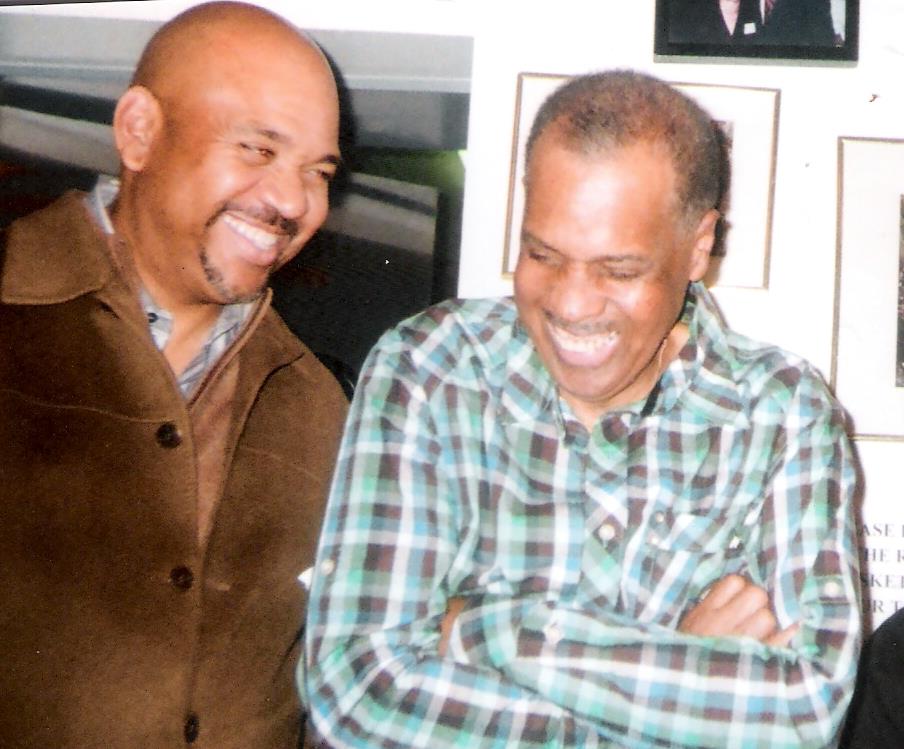

Former Washington Post columnist Michael Wilbon, Jim Brown and Lou Stokes (D-Ohio)
Jayson Whitlock is now the host of a podcast titled “FEARLESS”, several years he wrote a lionizing column for The Bleacher Repot titled, “Jim Brown My Hero.” The column must have had legendary Washington Post sports writer the late Shirley Povich turning over in his grave.
A press room at deadline is still the most segregated institution in America, with a church on Sundays running a close second.
Mr. Povich was the author of a best selling book titled “No Cheering in the Press Box.” I admired and respected the man. He and Sam Lacey, sports editor for the African-American newspaper, stood for something, and did not fall for just anything.
I never missed their commentaries, and columns here in my hometown of Washington, D.C. Their kind in sports writing have become endangered. They inspired me to to write commentaries for my radio sports talk show: “The Original Inside Sports.”
Jim Brown once said, “All Sam Lacey did was cover Jackie Robinson; he never really covered the NFL.” I wonder why? In the late 40s and 50s, Jackie Robinson was the most important black athlete of our time.
Mr. Whitlock’s ill-timed and idiotic column defending Tiger Woods and Michael Jordan against Jim Brown’s accusations as “Do nothing Negroes” was cheer leading at its worst. You would think Whitlock’s column would make the next sports columnist think twice before following in the same path. Enter Washington Post columnist and ESPN’s Pardon the Interruption co-host, Michael Wilbon.
I know this may sound familiar to some, but let me introduce you to Michael Wilbon in his own words, “Harold, I have not forgotten when I came to the Washington Post as a 22-year-old right out of college, I didn’t know diddly. You took me under your wing and had me on your sports talk show, Inside Sports. You sit me down and made sure I knew the Good Guy coaches in the city.”
I remember Wilbon’s column in the Washington Post was titled “Tiger’s Actions Speak Volumes.” Let me clear the air from the very beginning, I like Michael Wilbon, he is really a good person, but he is a go along to get along guy. He has never stood up for anything, including himself.
He has no track record of ever doing anything in the community before the Washington Post, but he should not feel like the Lone Ranger; he has plenty of company in the media. In our long association, he has always been a gentleman, and he has always kept his word with one exception.
During my radio days in the 70s and 80s, I had a pipeline into the Washington Post newsroom. My radio talk show, “The Original Inside Sports” was the No. 1 rated sports talk show in town. Long time sports editor George Solomon was my “Go to guy” in the sports department. George was a pretty smart guy, and much like Jim Brown, he thought he was smarter than anyone else. My show was like a “Watering Hole” for writers and sports columnist at the newspaper.
Longtime Washington Post High School Sports Editor Donald Huff once said, “George Solomon runs a tight ship when it comes to the sports department.” Despite that assertion, there were some great writers and reporters who worked for him. My favorites were Byron Rosen, and Tom Callahan (class acts).
If George wanted to know the latest on the Black Athlete or something going on in the black community, he knew he could hear it on Inside Sports. He was a consistent contributor, he participated in-studio, and there were long distance calls from Wimbledon and track meets and golf courses from around the World.
My community programs became one of his favorite hangouts, celebrity tennis tournaments, Christmas toy parties for needy children, etc. His staff followed his lead: Rosen, Callahan, Wilbon, Dave Dupree, Donald Huff, and Dave Aldridge all became regulars on Inside Sports. Somewhere in the 80s, I became a regular on the first televised Comcast Washington Post sports talk show.
Good Old Boys like Tony Cornhiser, John Feinstein, and his hatchet-man, Leonard Shapiro, kept their distance.
I clearly remember Shapiro taking a gamble to come on Inside Sports to plug his bogus book titled “John Thompson: The Real Story.” My first question to him was how could this be the Real John Thompson story when you didn’t interview him, or anyone in his family, and you never interviewed me? I am sure that was the longest hour he ever spent on radio.
I had known John Thompson since he was in middle school. During his playing days on the playgrounds in Northeast DC. He could have easily played the role of the Tin Man in “The Wizard of Oz” (no heart). I used to chase him off the basketball court and make him sit on the hill until his bodyguards arrived (Batman Grier and Sandy Freeman). He wanted to be a jump shooter instead of a rebounder, I was the designated shooter.
John Thompson’s NBA basketball claim to fame: “I backed up Bill Russell.” Red Auerbach put him in the expansion draft after his first year. He was the first 7-footer ever put in the expansion draft.
His NBA career was over, and down the drain in two years. He could not play dead. He was also overrated as a college coach. Media Scoop: With Big men like Pat Ewing, Alonzo Mourning, Dikembe Mutombo, Michael Graham, John Turner, etc., he should have easily won three National NCAA titles.
When he was first hired at Georgetown, he could not buy a story on any sports page, or time on any radio or television station to promote Georgetown basketball. I gave him a five-minute time slot every Monday evening on Inside Sports (W-O-O-K Radio) to promote his team.
He is another “know it all” in the community with no community track record. I assisted his wife, Gwen, in her divorce case. Big Bad John tried to intimidate her. He would show up unannounced and sit in a parked car or hide behind a tree in front of her residence late at night (in the black community, we call this Tree Boxing).
She took him to court and to the bank to the tune somewhere in the neighborhood of $6 million. It could have easily been $12 million but she wanted him out of her life. John was a millionaire before he left Georgetown. He was taking money under the table from sports agent David Falk. That is the Real John Thompson story.
Washington Post sports writer Dave Dupree was the first to write a story on my community involvement (Christmas toy parties hosted by the Washington Redskins), but he started to smell himself after he became a columnist.
We covered the Washington Bullets together during the 70s. The Bullets’ media press table was divided into two sections starting at half-court. White media sit to the left and those of us who where black sit to the right. Dave and I fell out of love in the visitor’s locker room after a Bullets’ game. I jokingly asked him why was he a no-show on Inside Sports, and he had a curt response, “I don’t work for Harold Bell.”
I mistakenly took it as a Dis aka disrespect. I slapped him in his mouth and all hell broke loose. Several of our colleagues stepped between us and I was hustled out the locker room. I still regret the incident. Dave was not really a bad guy.
The late Mark Splaver was the Director of Media Relations for the Bullets. One home game I arrived late after he had passed out media press guilds for the team. During half-time, I reminded him I had not received a press guild, he walked away without responding.
He returned in the third quarter and threw the guild on the table in my direction. I went after him for an explanation but Jerry Sachs the Vice-President of the team stopped me, and asked me to let him handle it, and I did.
The next home game, Mark came to the press table and apologized.
There was still a problem, I was appalled by the media seating arrangements, here it was in the late 70s and blacks in media were still being treated like second-class citizens.
In 1954, Rosa Parks had refused to get up and give her seat to a white man on a bus, and in 1968, the Rev. Martin Luther King gave his life in Memphis fighting for our civil rights.
Here we are in the late 1970s, Dave Dupree (Washington Post), Ron Sutton (WHUR Radio), Greg Mosso (WHUR Radio), Chuck Taylor (TV 20), Gerald Burke (Afro-American) and me were still sitting in separate but equal seats at the press table in the Nation’s Capitol. Something was wrong with this picture.
In 1974, I established a monthly Media Round Table on Inside Sports at W-O-O-K radio with members of the local media. It was here Frank Pastor, a white sports writer, and I decided we would switch seats at the next home game.
We met in the press room and walked down the steps to our seats, he went to the right and I went to the left. No one batted an eye.
It was integration without a protest sign or march, we just did a sit-in. The following season, the press table was fully integrated. Frank, and I gave each other a High Five to celebrate.
My problem with Michael Wilbon started in the Green Room on the campus of Howard University. We were killing time waiting to go on WHUT 32 Kojo Nnamdi’s television talk show.
It was here he confided in me that he didn’t like the way editor George Solomon was constantly looking over his shoulder and changing his columns.
Wilbon said, “He never does that to Tony Kornhiser. I am thinking since I am now a columnist, I should be free to write my own stories.”
Jill Nelson, a former Washington Post writer, wrote a book in 1993 titled “Volunteer Slavery/My Authentic Negro Experience.” She said, ‘the Washington Post is The Plantation on the Potomac.’
For a better understanding of his Trials and Tribulations with George Solomon, I gave Wilbon a copy of the book. I think that he is still without a clue.
My advice to Michael in the Green Room at the time was to take George to lunch away from the paper.
There he could let him know he appreciated his personal attention, but thought that he could manage his column by himself.
I also advised him to leave George with the impression he had no problem calling on him if he got stuck.
It looks like Michael decided to kiss George’s ass instead. He is now saying “Harold Bell, how do you like me now?” I wonder was it worth his peace of mind?
When I see Michael on television playing the “Expert” on anything and everything, I don’t find him believable.
I am thinking much like James Brown, he has been brought and sold several times over. There is a great possibility the system is still telling him how to say it and when to say it.
Much like Jayson Whitlock’s talk show on “My Hero Jim Brown,” Michael Wilbon crossed the line over and over again. For example; Wilbon, managed to kiss Tiger’s ass and Jim Brown’s ass in the same column.
I read the third paragraph leading into the story ‘Tiger’s Actions Speaks Volumes.’
He wrote, “Don’t get me wrong, I’ve admired Brown’s activism my entire adult life. One of the unforgettable experiences of my life came during the 1992 riots in Los Angeles, when Brown through his determination, concern and sheer force of personality, persuaded gang members from the rival Crips and Bloods to call a truce to the violence and talk out their differences at Brown’s Hollywood home.” Would someone please get the toilet paper!
In his next breath he goes on to tell how misguided Jim Brown is when it comes to Tiger’s contributions. He points out all the great things Tiger has done since he turned pro.
He reminds Jim that the Tiger Woods Foundation does not teach golf. He names the foundations activities; the courses taught at the academy such as, engineering, robotics, and marine biology.
Then he cites the 25 scholars the programs has produced and the schools they attend like Georgetown, Florida A&M, Spellman, Penn State, UDC, Marymount, the University of Arizona and the University of Idaho.
The learning center in California has had between 20,000 and 25,000 young people come through the doors.
Would someone please slow Michael down, and fit him for a short skirt and pom-poms. No Cheerleaders in the Press Box.
The bottom line, Tiger Woods, Michael Jordan, and Michael Wilbon are nobody’s bargains in standing up for the rights of minorities. Jim Brown is heads and shoulders above the three, but he stands for Jim Brown.
When Tiger was on the pro circuit he never hired a black caddy for the tour. He had an opportunity to give a Black Man a chance to become a millionaire, but never did.
According to my former high school teammate and college roommate Richard “Jelly” Hansberry, Tiger barely spoke to the black caddies on the tour.
Jelly once served as the Caddy Association’s Vice-President. He was on the tour for several decades.
Black caddies have become an endangered species on the pro tour (I was one in high school).
When the ruling was made that the tour’s pro golfers had to start paying the caddy a percentage of their earnings, they immediately started to hire people that looked like them (family and friends).
I have no problem with that. Tiger on the other hand, hired people he wanted to look like.
Michael Jordan used to be Wilbon’s go-to guy. He has evidently fell out of a favor since Wizards owner Abe Pollin ran him out of town with his tail tucked between his legs and his foot on the gas pedal crying foul.
On the HBO special, Jim lumped Michael and Tiger in together, but Wibon never mentioned or defended MJ in his column.
Michael Wilbon is a contradiction. He closed his column with “I asked Tiger if it’s possible that a conversation with Jim Brown might be productive, and Tiger answered, ‘That depends on whether both parties show up open minded.'”
Wilbon needs to get his own house straightened out before he can straighten out someone else’s.
In the three decades I have known Michael, he has never made an effort to donate a toy, book, shoes, a dollar or Send A Kid to Camp for my non-profit organization Kids In Trouble, Inc.
But he says “I have not forgotten.” He has made promises but has never followed through. He is still a lovable guy, but he is mis-guided.
He should not feel like the Lone Ranger: neither have benefactors like John Thompson, Sugar Ray Leonard, Adrian Branch, James Brown, Howard White, and Adrian Dantley (he lost of millions of dollars to David Falk’s miss using his money).
David Aldridge is a “Good Guy” and I thank him for reaching back, and there when I needed him.
There are some champions and some chumps among the group, mostly chumps.
There is one thing that is certain, whatever they are doing in the community or in the media, they are all following my Footprints in the Sand.
Several years ago, Michael had a life and death health crisis. I e-mailed him wishing him well, and a speedy recovery.
He responded with “Harold, I was not surprised to hear from you, and I thank you for the thought. I am just disappointed when you get upset when people disagree with you.”
Wilbon, recently aired a broadcast where he called out his main man, First Take’s, Stephen A. Smith. His claim, Smith copied programming from ‘Pardon the Interruption’ for his success.
Michael is talking out of both sides of his mouth. He has never expressed to me vocally or in written word about something I had written that he disagreed with.
I e-mail James Brown, Sugar Ray Leonard and Michael, whenever their names appear in my commentaries.
I don’t want them getting second-hand information. He say, she say, and anonymity are dangerous weapons are often used in the Black community to purposely cause confusion among the natives.
I understand that I am on the firing line every time I pen a commentary or column. My greatest asset is that I can tell the difference between Constructive Criticism and Destructive Criticism. Michael should not take everything personal, but if the shoe fits wear it.
On chance encounters with Michael over the years, for example, there was the time I bumped into him coming out of the Washington Post in 2004.
The first thing he wanted to talk to me about was the book he was writing with Charles Barkley. No mention of any conflict with me.
In our last encounter I went a Wizards’ game to witness the return of Agent Zero aka Gilbert Arenas. The Wizards were facing the best team in the NBA, the LeBron-James led Cleveland Cavaliers.
I met Michael in the press room and you should have seen the surprised look on his face when he saw me. The relief came when he saw I had my wife Hattie with me. She was his comfort zone.
He knew I would not be all over him with her by my side. We smiled and made small talk about his $1,000 suit and $500 pair of shoes.
There was never a word about my commentaries or columns about him or his colleagues. There is still no defense against the truth.
Michael, I understand the need to have access to Tiger and MJ on your side, but you don’t need to be a cheerleader. I suggest you try speaking volumes about your own life and let Tiger speak for himself.
JOHN THOMPSON III: MOMMY’S BABY, DADDY’S MAYBE?
The following is an excerpt from an article on the Fox Sports Network by Jason Whitlock about former Georgetown basketball coach John Thompson:
“The Fab Five are taking credit for the real accomplishments of John Thompson’s and Patrick Ewing’s Georgetown Hoyas.
“It was Thompson’s all-black, Ewing-led teams a decade before the Fab Five that shook the foundation of college basketball, changed the complexion of starting lineups across the country, opened coaching doors that had previously been closed to blacks and paved the way for black sportswriters at major newspapers.”
Jason, got it all wrong; he had forgot on March 19, 1966 the NCAA men’s basketball title game when all-white and No. 1-ranked Kentucky faced an all-black Texas Western team?
The game took place at the University of Maryland’s Cole Field House. I was there when Texas Western pulled the biggest upset in college basketball history. That team changed the face of college basketball forever—not John Thompson Jr.
John Thompson and Georgetown University did absolutely nothing to pave the way for black sportswriters at major newspapers He, in fact, did much like Don King did in boxing—he stunted the growth of blacks in the media by refusing access to his players. He has since become a “know it all” in so-called major media and looking over the shoulder of John Thompson III while he tries to coach the Georgetown University basketball team.
The Washington Post sports editor at the time, George Solomon, and his staff were treated like sports media stepchildren. Former Washington Post sports writers Dave Dupree, Michael Wilbon and David Aldridge all had front-row seats to his sports media charade.
When he could not win a game and had no one in so-called major media to promote Georgetown basketball, he turned to a little black-oriented radio station W-O-O-K and The Original Inside Sports, hosted by yours truly. I gave him 5 minutes to promo Georgetown basketball every Monday.
When he finally had some winning success, he hired a white man as his play-by-play announcer for Georgetown basketball, at none other than W-O-O-K Radio.
He would never tell how he got his first radio experience on The Original Inside Sports on W-O-O-K Radio with Harold Bell.
Jason, I was also puzzled by your quote saying, “It’s easy to forgive Jalen Rose for his lack of self-awareness. It’s America. In this country, self-awareness and common sense are our most rare commodities.”
Jason, must have been asleep under a rock when Kentucky and coaching icon Adolph Rupp played Texas Western, I wonder where was his self-awareness?
This observation by him was really over the top when he said, “John Thompson’s players were the inner-city black kids who left a legacy of jobs and playing opportunities for other impoverished minorities that exposes the lack of substance in the Fab 5’s popularization of college basketball.”
He put his foot in his mouth again he said, “Hoya Paranoia is the story that deserves celebration and should serve as a teaching tool. Fab Five is a safe, harmless story celebrating black kids for choosing style over substance.”
You really think that the John Thompson and Hoya Paranoia deserves a celebration?
If you interviewed 100 former Georgetown players off the record, I bet 90 will say John Thompson was a fraud!
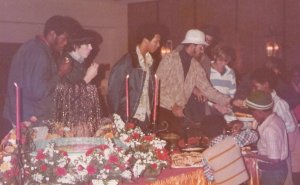
Georgetown players like star player Merlin Wilson (left) and his teammates serve kids at one of my annual KIT toy parties
He betrayed both his wife and his lifetime friend, protector and assistant coach Bob Grier (aka “Bat Man”) by stealing the affections of Grier’s girlfriend, Georgetown academic advisor Mary Finley. He also kicked Mike Riley, his former player and assistant coach for over three decades, to the curb and under the bus. The word loyalty to John is spelled O-N-E W-A-Y!
I have known John Thompson since he attended my alma mater, Brown Middle School, in northeast Washington, DC. I was there to watch him develop as a player and a coach, and he was overrated in both.
John’s NBA career was a bigger fraud than his college coaching career. His NBA claim to fame? “I backed up Bill Russell.” The late Boston Celtic coach, the legendary Red Auerbach, was a dear friend and mentor to me. I know how much backing up Russell he did. It was like sending a sailboat to back up the sinking of the Titanic—one of the same!
Auerbach put John into the expansion draft because he was too soft. Check out how many seven-footers were put in the expansion draft during the Red Auerbach and Bill Russell era. The “Big Bad John” you saw and heard during coaching career , saw the handwriting on the wall and retired from the NBA.
I already knew what Red had known all the time: You can’t teach and dictate—-heart.
John Thompson could have played the lead role of The Tin Man on Broadway and in the movie The Wizard of Oz. He had no heart!
As those of us who knew the real John Thompson have often said, “If he had his high school teammate Tom Hoover’s heart, he would have been a world-beater.” Hoover played in the NBA for several years as an “enforcer” and “hatchet man” for the New York Knicks.
Back in the day on the playground, when John tried to play like a point guard, I would banish him from the court and make him sit on the hill. He’d sit there until Sandy Freeman and Bob Grier, his protectors, showed up. He would dare not raise his voice and use the type of profanity he used as the coach on the Georgetown bench. I have no idea where he picked up that part of his coaching personality (Bobby Knight).
John Thompson’s secret to success: He was big and black, and he used profanity and “the race card” to successfully intimidate his players and white folks! He gained wide recognition in the sports world when he hugged Hoya player Freddy Brown after he mistakenly threw a pass intended for one of his teammates to North Carolina’s James Worthy. It was the closing seconds of the 1982 NCAA tournament final, and the outcome of the game—an eventual 63-62 loss—was still hanging in the balance.
After the game, Thompson was seen hugging Brown in a picture that went around the sports world. Today, Freddy Brown’s feelings about his old coach are X-rated. In a Washington Post magazine article, John said, “My mother better not get in my way when a dollar is on the line.” In that same story, he claimed money could overcome racism in America.
Sometimes it is best to be thought a fool than to open your mouth and remove all doubt.
Early in his second season at Georgetown, when his job was on the line, in the wee hours of the morning someone hung a banner in the Georgetown Gym that read “John Thompson the nigger coach must go!” Back then I was his first line of defense in the media. When he called my home at 3 a.m. explaining what had happened, I was pissed off. I called the troops (black media) to meet me at Georgetown the next morning for a press conference involving John Thompson. I was told by John the President Timonthy Healy the man responsible for hiring him had called the press conference.
In 1972 John took over a Georgetown basketball team that had gone 3-23. In 1973 George town was still having a difficult time winning games. In the wee hours of the morning after another lost someone hung a banner saying, “John Thompson the nigger coach must go!”
I must admit, he played me like a beaten drum. I later discovered he’d hung the banner himself.
All that mattered to him was the end result: It helped him keep his job.
The University President Father Henley was scared of the institution being seen in the national spotlight as racist. He assured media at a hastily called press conference that John Thompson’s job was safe. Mission accomplished, and the rest is tainted college basketball history.
This is the same college coach who took money under the table from his Georgetown-designated player sports agent, David Falk. The player transactions and kickbacks made him a millionaire before he left the university.
Falk also short changed NBA Hall of Fame player Adrian Dantley out of several million dollars, according to Dantley.
I don’t even want to think about how much money I’ve heard he misused from the bank accounts of Michael Jordan, Patrick Ewing, Alonzo Mourning and Dikembe Mutombo.
Former Maryland University and NBA All-Star John Lucas was also one of his suckers. John is one of my favorite people, but he got caught up in the hype.
In a conversation with Dantley on his last visit to DC as an assistant coach with the Denver Nuggets, he said, “David was not alone when it comes to laying the blame for misusing my money. Donald Dell, the CEO and founder of the company ProServe, must share some of the responsibility.”
Dantley learned of the fraud when I called his mother Virginia and informed her of the missing monies from his account. She was at first in denial, but Dantley’s new wife, who was an attorney, had an audit of Falk’s books.
In the meantime, John Thompson’s financial empire continued to grow. There were the slot machines, real-estate deals and the home he shared with his white mistress Mary Finley in Las Vegas. Please excuse “the race card”! This proves that not everything that happens in Vegas stays in Vegas.
The Washington Post published Pt. 1 of a two-part series investigation of these undercover discrepancies, but Pt. 2 never appeared. The investigative journalist was Bill Brubaker. According to my newsroom sources at the Washington Post, all said the exact same thing: Sports Editor George Solomon killed the series without explanation.
The Washington Post investigation was inspired by my January 22, 1999 commentary in the Afro-American Newspaper, titled “The Two Faces of John Thompson.”
John Thompson also lied about how he stared down and backed drug kingpin and killer Rayful Edmond into a corner.
The lie or rumor was that Thompson threatened Edmond to stay away from his players.
If you believe John Thompson did that, you also believe Jason Whitlock’s story of how Big John changed the face of college basketball.
I spoke with the late DC police chief, Maurice Turner, and a DEA supervisor friend of mine who was also involved in the case—both said nothing could have been further from the truth.
Chief Turner said, “When John was meeting with Rayful, he called me every hour on the hour to make sure I would have a police presence to protect him. He was scared to death.”
The lies continue; I have not forgotten the Nike deal that he carved out at my expense.
I was the first ever Nike sports and marketing representative hired here in the DC metro area. As a rep, my role was to outfit the different athletes, media, entertainers and politicians with the Nike brand. In other words, I gave away Nike apparel.
Once I became established as the Nike rep, I contacted my college coach, the legendary Clarence “Bighouse” Gaines of Winston-Salem State. I wanted him to outfit his team with the Nike brand. But he had an ongoing deal with the great and legendary coach John McLendon. Coach McLendon was a rep for Converse.
I then took the same proposal to the campus of Georgetown for my good friend John Thompson to look over. Remember, this is the same brother I gave five minutes to promote Georgetown basketball every Monday on Inside Sports.
He looked over the proposal and said he would get back to me. I left the campus and started the walk back to the Nike store, which was just a few minutes from the campus. When I arrived at the store, I received a telephone call from Nike NBA promotions and marketing rep John Phillips. He was responsible for hiring me.
I returned his call to the home office in Portland, Oregon, only to discover my friend John Thompson had called to cut his own deal!
John Thompson is truly a backstabber in every sense of the word. His loyalty is only to himself!
The changes that he put me through are nothing compared to the changes he put his family though. You will never see or hear “The Real Warrior,” his ex-wife Gwen, who is responsible for holding the family together. I was in attendance at their wedding.
Gwen is the real “Undercover Boss” of the family and she is totally responsible for the three children turning out to be decent human beings.
When she filed for divorce, “Big John” became a stalker hiding behind trees outside of her residence trying to intimidate her. It got so bad, one of her close friends had her lawyer call me to advise her on how to proceed against his bullying tactics.
The last thing he wanted to do was go to court, where all his skeletons would come out his closet.
My advice to her lawyer: stay the course and keep the threat of a courthouse appearance as a vehicle for an out-of-court settlement. He settled out of court.
I gave Big Bad John and his Georgetown basketball team their first ever “community presence” as Santa’s Helpers at my annual Christmas toy parties for needy children. Ronnie would often accompany him to the parties.
Ronnie Thompson, his youngest son and a Comcast sportscaster, is named after his father’s former “best friend,” Ronnie Watts. Ronnie is a native Washintonian, and played basketball at Wilson High School and Wake Forest University in Winston-Salem, NC.
He played several years in the NBA with the Boston Celtics. Ronnie and Bill Russell were great friends and were often seen on television in AT&T telephone commercials together.
Ronnie is a great human being; he disappeared without a trace. It is rumored that John also put him in a financial trick bag.
John’s favorite “bagman” was James Wiggins. Wiggins was a local high school booster. He served as John’s right-hand man for the Urban Coalition Basketball Summer League. They are no longer friends: Wiggin’s hands are just as dirty as John’s. Rumor has it that these two parted ways because one of the bags of cash came up missing.
David Falk is still operating out of Georgetown for John Thompson III, so that means little has changed—like father, like son. The more things change, the more they remain the same.
John’s old friend Sandy Freeman, at a recent high school alumni summer picnic, told me he had a recent conversation with John and he said, “Harold Bell holds a grudge too long!”
That takes the cake; this is the kettle calling the pot black again. Former DeMatha High School coach and basketball Hall of Famer Morgan Wooten is one of the class acts in all of sports, but John Thompson has been “player hating” on him for decades!
Big Bad John, I have forgiven but I have not forgotten!
Forgiveness Is…
- A journey, rather than an event
- A form of remembering
- An act of empowerment
- The result of a conscious decision more than an emotion
- A denouncing of the wrongful act
- Making right what can be fixed and letting go what cannot
- An acknowledgement of the intrinsic worth of the offender
- A gift, rather than a burden
Forgiveness Is Not…
- Excusing what happened
- Forgetting
- Tolerating continue wrongdoing
- Denying our anger
- Letting people off the hook
- Saying “It does not matter”
- Feeling an emotional “love” for the offender
- Something that can be willed
DICK HELLER A CLASS ACT: THANKS FOR THE MEMORIES AND SUPPORT!

Top Photo: Dick Heller receives KIT Life Time Achievement Award from Green Bay Packer great Willie Wood. No. 30 Maury Wills, No. 24 Willie Wood, No. 11 Earl Lloyd all benefited from Dick’s honest sports reporting when it came to the local athlete.
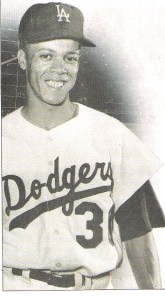
When my friend and mentor Dick Heller went home to be with the lord last year he left a void in the integrity of sports reporting. Dick had watched several of DC’s finest athletes came up on the short end when the powers-to-be were giving credit where credit was due. He gave credit where credit was due and several DC local athletes benefited including, Willie Wood, Earl Lloyd, Maury Wills and yours truly.
For example; DC public high school legend and NFL Green Bay Packer great Willie Wood was a Heller favorite. Willie was left on the outside looking in while his Packer teammates were being inducted into the NFL Hall of Fame. He was being blackballed by the powers-to-be. It was Dick who took the media lead in campaigning for Willie’s induction. In 1989 almost 20 years after his retirement he was finally inducted into the hollowed halls of the NFL Hall of Fame, thanks to Dick Heller.
The story of media reach-back continued:
Alexandria, Virginia native and Parker Gray High School basketball legend Earl Lloyd was all but forgotten for his pioneering efforts in the NBA. Dick teamed up with NBA legendary Boston Celtic coach Red Auerbach. They campaigned for Lloyd’s overlooked induction into the NBA Hall of Fame.
It took 53 years after his NBA debut on October 31, 1950 before the NBA finally remembered Earl Lloyd. He was inducted as a contributor in 2003.
The Boston Celtics’ Chuck Cooper was the first to sign an NBA contract but Earl was the first to play in a game. He beat Chuck by one day! Thanks again Dick Heller.
The beat goes on, DC Public high school legendary all-around athlete, Maury Wills (aka Sonny) revolutionized the art of base stealing and changed the way Major League Baseball played the game from first base to home plate. His legs changed the game from power to speed.
In 1962 he actually ran the great Ty Cobb out of the record books. Cobb was considered the King of the stolen base before Sonny entered baseball in 1959 after spending 8 years in the Dodger farm system.
It was at Busch Stadium on September 23, 1962 that he stole his 97th base of the season. He shattered the major League record held by the immortal Cobb. The record had stood for 47 years.”
In a story written by Dick in the Washington Times in September of 2003 he said, “It was a game against the St. Louis Cardinals that I saw Maury running with the pitch from right-hander Larry Jackson. Catcher Carl Sawatski’s hurried throw got past shortstop Dal Maxvill as he slid safety into second.
According to Dick, “there was no great uproar compared with that of a year earlier when Roger Maris surpassed Babe Ruth’s 1927 total of 60 home runs.
Sonny was 26 years old in 1959 and he took the Dodgers from 7th place to first and won the World Series!
The 8 years he spent in the Dodger farm system he became all that he could be. He taught himself how to hit from both sides of the plate (switch hitter). He stole 50 bases in 1960 and 35 in 1961, leading the National League both years. 1962 would be his breakout year.
The eyes of baseball were on him and the Dodgers fans were wondering how many bases would he steal in the 62 season! He finished the year with 104 stolen bases in 117 attempts. This gave him a success rate of of 89% that shattered Cobb’s record of 71% (96 of 135) in 1915. His record has since been surpassed by former Cardinal great Lou Brock and the “How great I am” Ricky Henderson (twice). But it was Sonny Wills who put the excitement and flash of the stolen base back into baseball after several decades where a total low of 15 once led the league (Dom DiMaggio in 1950).
After his great season (208 hits, .299 BA to go with his stolen base record and a anemic $30,000 salary, he was looking for a hefty raise for the upcoming 1863 season.
Sonny said, “I went into (vice-president) Buzzi Bavasi’s office looking to cash in and I came out 15 minutes later happy that I was still on the team. Buzzie had an unfriendly way of negotiating, he finally gave me a $20,000 raise and told me not to tell anyone.”
Sonny Wills was from “Parkside” the same NE housing project I grew up in. Confidence was not in short supply in the Wills’ household. There were 12 other siblings and he was not even the best athlete or best baseball player in the family.
I lived on Kenilworth Terrace and his family lived on Kenilworth Avenue one street over. His father was a minister and he ran a tight but a close knit family ship.
Sonny is definitely one of the greatest all-around athletes to come out of the DC Public School system (Cardozo). I admired and looked up to him growing up. He was a great running back in high school and played with the Stone Walls A. C. a top notch DC amateur football team. My Spingarn high school coach Dave Brown would often arrange for us to scrimmage against the Stone Walls. I had an opportunity to see Sonny up close and personal. It was definitely men against boys!
His brother Donald (QB) and I (WR) were the touchdown combination at Spingarn HS. Donald (aka Duck) and I decided to continue our education at Winston-Salem State University in North Carolina to play for the legendary coach, Bighouse Gaines.
In 1962 during Sonny’s record breaking year I remember joining the Wills family on a bus trip to see the Dodgers take on the Philadelpia Phillies in Philly. Donald and I had a plan to ask Sonny for some money to help support us in school.
We waited for him at the visitors exit after the game. First, there were hugs and kisses with family and friends. I don’t remember how we got him by himself for a minute, but Donald did ask him for some money to help us in school. He cried broke.
He explained he was broke in the life style he was living and not really broke in our lifestyle. I walked away in disbelief.
I now understand exactly where he was coming from after reading the story in Dick’s column about how cheap the Dodgers were after his record breaking year and how he had to beg for a $20,000 raise.
He did not forget us, he eventually send a $25,000 check down to Winston-Salem. The check came from a sponsor of the MVP Award that he received for his record breaking year.
The award came with strings attached. The player receiving the award had to donate it to a non-profit organization. Enter; Winston-Salem State University.
The money went directly into the school’s athletic fund, I am sure Bighouse gave Duck some money off the top.
Sonny’s stats and winning ways as a Dodger during a brilliant career screams “Hall of Fame!” The Dodgers won pennants in 63, 65 and 66. They just missed in 1962 losing to the Giants in a play-off.
There is no argument that he revolutionized the game with his legs. He changed the game from power (home run) to speed (stolen base).
He had a brief run with the Pirates before returning to finish his career with the Dodgers in 1972.
Sonny Wills was a outspoken and stong-minded individual. He was not always the most popular of players (sounds familiar). He dated the cream of the crop, white Hollywood stars like Doris Day, and anybody else he wanted. He thumped his nose at the media when questioned about his life style.
His drug and alcohol abuse along with tabloid news about disputes with his son “Bump” Wills also a major league baseball player won’t help. His fling with Doris Day and his Major League managerial record (26-56) with the Seattle Mariners, all of this will give the naysayers an excuse not to nominate for induction into the Baseball Hall of Fame.
During his career Sonny found little reason to come back home accept for death in the family and sometimes he didn’t make some of those funerals.
He did comeback to have Banneker Baseball field located across the street from Howard University named after him. All this was around the same time Major League Baseball was returning to the Nation’s Capitol. He was searching for a job but there were no takers!
Dick Heller’s campaign to get Sonny inducted into the Baseball Hall of Fame does not look promising, but I wonder what is keeping him out of the DC Sports Hall of Fame? Could it be the same “Good Old Boy” attitude has spilled over into the local hall of fame?
Sonny and I have not always seen eye to eye. There were times when I thought he was too selfish when it came to family and friends, but that has become a normal trait in our community.
We went our separate ways when he forgot to call Dick Heller and thank him for the outstanding column written on his behalf.
Despite the misgivings he deserves to be in the Baseball Hall of Fame. He earned it the hard way—hard work!
Dick might just have to settle for two out of three (Wood and Lloyd). Michael Wilbon was just inducted into the DC Sports Hall of Fame (for what?). What is the criteria? I would guess Tony Cornhiser and Chuck Brown are next up!
This type of “Blackballing” sounds like the 1800’s when they tried to crucify the first black Heavyweight Champion of the world, Jack Johnson.
The Powers-To-Be came up with “The Mann Act.”
This was a law drummed up by some racist stating “A black man could not transport white women across state lines for immoral purposes.”
The more things change the more they stay the same.
There have been recurring proposals to grant Johnson a posthumous presidential pardon. A bill requesting President George W. Bush to pardon Johnson in 2008, was passed in the House, but failed to pass in the Senate. In April 2009, Senator John McCain, along with Representative Peter King, filmmaker Ken Burns (all white men) requesting a presidential pardon for Johnson from guess who, the first black President of the United States.
Barack Obama, President of all the people? He has yet to move on the recommendation. How can we as black folks bad mouth George W. Bush?
On July 29, 2009, Congress passed a resolution calling on President Obama to issue a pardon.
Remember, this is the same President who had a beer in the Rose Garden with a white racist Boston cop and recently took the time out with Tiger Woods to play a round of golf, but has not had time to sign off on a pardon for Jack Johnson. Come on MAN!
What’s the problem, is Johnson too black? Yea, I know the “Race Card” but does it count when it is black on black crime?
Maury Povich, Bob Addie, Tom Callahan, Byron Rosen (Washington Post), *Mo Seigel (Washington Star/Times) were the cream of the crop when it comes to honesty, integrity and calling a spade a spade. They were all great writers—Dick Heller belongs in that same class.
*Mo Seigel could sometimes be brutally honest

 theoriginalinsidesports